
Ethyl 2-(3-bromophenoxy)propanoate
CAS No.:
401791-40-0
M. Wt:
273.12300
M. Fa:
C11H13BrO3
InChI Key:
YHUQGBQWTMLYAB-UHFFFAOYSA-N
Appearance:
Clear
Names and Identifiers of Ethyl 2-(3-bromophenoxy)propanoate
CAS Number |
401791-40-0 |
|---|---|
MDL Number |
MFCD16089525 |
IUPAC Name |
ethyl 2-(3-bromophenoxy)propanoate |
InChI |
InChI=1S/C11H13BrO3/c1-3-14-11(13)8(2)15-10-6-4-5-9(12)7-10/h4-8H,3H2,1-2H3 |
InChIKey |
YHUQGBQWTMLYAB-UHFFFAOYSA-N |
Canonical SMILES |
CCOC(=O)C(C)OC1=CC=CC(Br)=C1 |
UNSPSC Code |
12352100 |
Physical and chemical properties of Ethyl 2-(3-bromophenoxy)propanoate
Exact Mass |
272.00500 |
|---|---|
LogP |
2.77950 |
Molecular Formula |
C11H13BrO3 |
Molecular Weight |
273.12300 |
PSA |
35.53000 |
Safety Information of Ethyl 2-(3-bromophenoxy)propanoate

Applications of Ethyl 2-(3-bromophenoxy)propanoate
Ethyl 2-(3-bromophenoxy)propanoate has diverse applications across several fields:
- Organic Synthesis: It serves as an intermediate for synthesizing more complex organic molecules.
- Pharmaceutical Development: Due to its potential biological activity, it may be explored as a lead compound in drug discovery.
- Agricultural Chemicals: This compound could be utilized in the formulation of agrochemicals due to its structural properties.
Interaction Studies of Ethyl 2-(3-bromophenoxy)propanoate
Studies focusing on the interactions of ethyl 2-(3-bromophenoxy)propanoate with biological targets are essential for understanding its potential therapeutic applications. Research may involve:
- Investigating binding affinities with specific enzymes or receptors.
- Assessing its effects on cellular pathways and biological processes.
- Evaluating its safety and efficacy in preclinical models.
Biological Activity of Ethyl 2-(3-bromophenoxy)propanoate
Research indicates that compounds similar to ethyl 2-(3-bromophenoxy)propanoate may exhibit various biological activities. These include:
- Antimicrobial Properties: Some brominated compounds are known for their antibacterial and antifungal activities.
- Enzyme Inhibition: The structural characteristics of ethyl 2-(3-bromophenoxy)propanoate may allow it to interact with specific enzymes, potentially acting as an inhibitor.
- Receptor Binding: The compound's ability to mimic biologically active molecules suggests it could bind to specific receptors, influencing physiological responses.
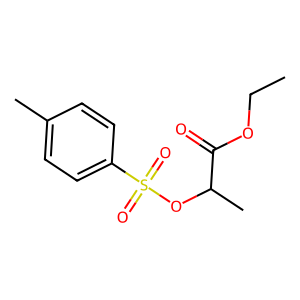 Cas:57057-80-4

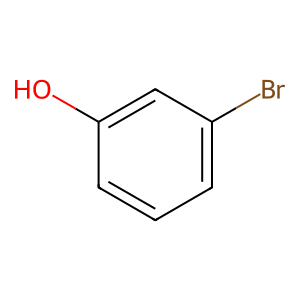 Cas:591-20-8

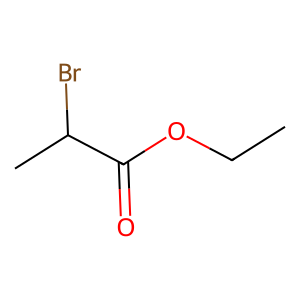 Cas:535-11-5