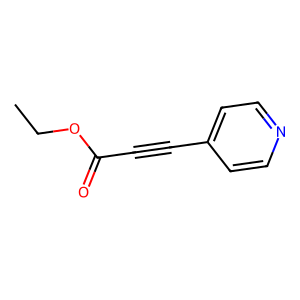
Ethyl 3-(4-Pyridyl)propiolate
Names and Identifiers of Ethyl 3-(4-Pyridyl)propiolate
CAS Number |
66869-71-4 |
|---|---|
MDL Number |
MFCD23381103 |
IUPAC Name |
ethyl 3-pyridin-4-ylprop-2-ynoate |
InChI |
InChI=1S/C10H9NO2/c1-2-13-10(12)4-3-9-5-7-11-8-6-9/h5-8H,2H2,1H3 |
InChIKey |
DJFGCHADKAHSFR-UHFFFAOYSA-N |
Canonical SMILES |
CCOC(=O)C#CC1=CC=NC=C1 |
UNSPSC Code |
12352100 |
Physical and chemical properties of Ethyl 3-(4-Pyridyl)propiolate
Acidity coefficient |
2.96±0.26(Predicted) |
|---|---|
Boiling Point |
123 °C(Press: 0.9 Torr) |
Density |
1.15±0.1 g/cm3(Predicted) |
Exact Mass |
175.06300 |
LogP |
0.99620 |
Molecular Formula |
C10H9NO2 |
Molecular Weight |
175.18400 |
PSA |
39.19000 |
Safety Information of Ethyl 3-(4-Pyridyl)propiolate

Applications of Ethyl 3-(4-Pyridyl)propiolate
Ethyl 3-(4-Pyridyl)propiolate finds applications across various domains:
- Medicinal Chemistry: Used as a precursor for developing anti-cancer drugs and other therapeutic agents.
- Material Science: Its unique properties allow it to be utilized in creating functional materials with specific characteristics.
- Chemical Synthesis: Acts as a building block in organic synthesis, particularly in forming complex molecules through reactions like cycloaddition.
Interaction Studies of Ethyl 3-(4-Pyridyl)propiolate
Interaction studies have demonstrated that Ethyl 3-(4-Pyridyl)propiolate interacts with various biomolecules, including enzymes and receptors. These interactions can lead to significant biological effects, such as inhibition or activation of specific pathways involved in disease processes. Molecular docking studies further elucidate these interactions, providing insights into potential mechanisms of action.
Biological Activity of Ethyl 3-(4-Pyridyl)propiolate
Research indicates that Ethyl 3-(4-Pyridyl)propiolate exhibits significant biological activity. It has shown potential as an anti-cancer agent, demonstrating cytotoxic effects against various cancer cell lines. Additionally, it interacts with several enzymes and proteins, indicating its role in biochemical pathways. The compound's structural features contribute to its ability to modulate biological systems effectively.
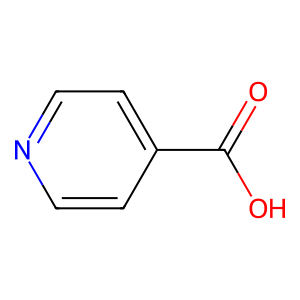 Cas:55-22-1

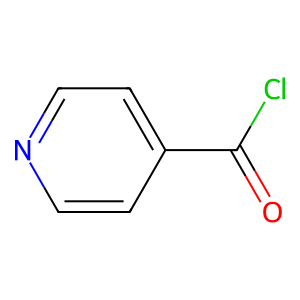 Cas:14254-57-0