
Ethyl 3-hydroxy-2,2-dimethylbutanoate
CAS No.:
69737-23-1
M. Wt:
160.21100
M. Fa:
C8H16O3
InChI Key:
DPZVLAWBYJYWFX-UHFFFAOYSA-N
Names and Identifiers of Ethyl 3-hydroxy-2,2-dimethylbutanoate
CAS Number |
69737-23-1 |
|---|---|
IUPAC Name |
ethyl 3-hydroxy-2,2-dimethylbutanoate |
InChI |
InChI=1S/C8H16O3/c1-5-11-7(10)8(3,4)6(2)9/h6,9H,5H2,1-4H3 |
InChIKey |
DPZVLAWBYJYWFX-UHFFFAOYSA-N |
Canonical SMILES |
CCOC(=O)C(C)(C)C(C)O |
Physical and chemical properties of Ethyl 3-hydroxy-2,2-dimethylbutanoate
Boiling Point |
228.251ºC at 760 mmHg |
|---|---|
Density |
0.989 g/cm3 |
Exact Mass |
160.11000 |
Flash Point |
87.3ºC |
LogP |
0.95650 |
Molecular Formula |
C8H16O3 |
Molecular Weight |
160.21100 |
PSA |
46.53000 |
Storage condition |
Refrigerator |
Applications of Ethyl 3-hydroxy-2,2-dimethylbutanoate
Ethyl 3-hydroxy-2,2-dimethylbutanoate finds utility in several fields:
- Flavoring and Fragrance Industry: Its pleasant odor makes it suitable for use in flavoring agents and perfumes.
- Pharmaceuticals: Potential applications in drug formulations due to its biological activity.
- Chemical Synthesis: As an intermediate in organic synthesis processes, particularly in creating other complex molecules.
Interaction Studies of Ethyl 3-hydroxy-2,2-dimethylbutanoate
Interaction studies involving ethyl 3-hydroxy-2,2-dimethylbutanoate focus on its reactivity with other chemical species. These interactions can include:
- Reactions with Nucleophiles: The electrophilic nature of the carbonyl carbon allows for nucleophilic attack.
- Solubility Studies: Understanding how this compound interacts with solvents can inform its applications in formulations.
Further research is needed to elucidate specific interactions and their implications for practical uses.
 Cas:547-63-7

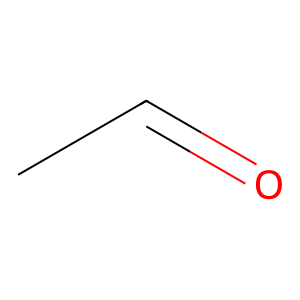 Cas:75-07-0

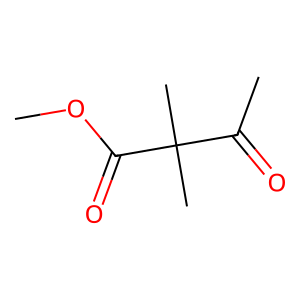 Cas:38923-57-8