
Ethyl 4-phenylbutanoate
Names and Identifiers of Ethyl 4-phenylbutanoate
CAS Number |
10031-93-3 |
|---|---|
EC Number |
600-062-4 |
MDL Number |
MFCD00026923 |
IUPAC Name |
ethyl 4-phenylbutanoate |
InChI |
InChI=1S/C12H16O2/c1-2-14-12(13)10-6-9-11-7-4-3-5-8-11/h3-5,7-8H,2,6,9-10H2,1H3 |
InChIKey |
GGFNXKFGVQQNRV-UHFFFAOYSA-N |
Canonical SMILES |
CCOC(=O)CCCC1=CC=CC=C1 |
UNII |
BU9R7P5U55 |
UNSPSC Code |
12352100 |
Physical and chemical properties of Ethyl 4-phenylbutanoate
Boiling Point |
275.00 to 276.00 °C. @ 760.00 mm Hg |
|---|---|
Density |
0.986-0.992 |
Exact Mass |
192.11500 |
Flash Point |
114.4ºC |
Index of Refraction |
1.489-1.495 |
LogP |
3.263 (est) |
Melting Point |
-13°C(lit.) |
Molecular Formula |
C12H16O2 |
Molecular Weight |
192.25400 |
PSA |
26.30000 |
Solubility |
Soluble (in ethanol) |
Storage condition |
Sealed in dry,Room Temperature |
Vapour Pressure |
0.00476mmHg at 25°C |
Safety Information of Ethyl 4-phenylbutanoate

Applications of Ethyl 4-phenylbutanoate
Ethyl 4-phenylbutanoate finds applications across various fields:
- Flavoring Agent: Its fruity aroma makes it a popular choice in food flavoring and fragrance formulations.
- Pharmaceuticals: It serves as a synthetic intermediate in the production of various pharmacologically active compounds.
- Biochemical Research: Due to its biological activity, it is utilized in studies related to cell signaling and metabolic pathways.
Interaction Studies of Ethyl 4-phenylbutanoate
Research on ethyl 4-phenylbutanoate has explored its interactions with biological systems. Studies indicate that it may influence lipid metabolism and exhibit antioxidant effects, potentially impacting cellular health and function. Additionally, investigations into its role as a signaling molecule suggest that it could modulate various biochemical pathways.
Biological Activity of Ethyl 4-phenylbutanoate
Ethyl 4-phenylbutanoate exhibits notable biological activities. It has been studied for its potential antioxidant properties, which may contribute to its role in protecting cells from oxidative stress. Additionally, it has been investigated for its effects on lipid metabolism and cell signaling pathways, indicating its relevance in biochemical research and potential therapeutic applications.
Physical sample testing spectrum (NMR) of Ethyl 4-phenylbutanoate

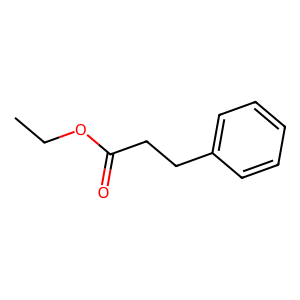 Cas:2021-28-5

 Cas:74-95-3

 Cas:64-17-5
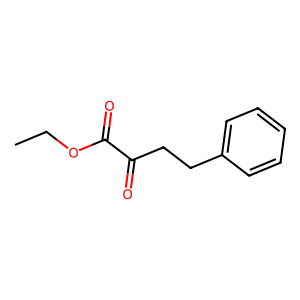 Cas:64920-29-2