
Ethyl acetimidate
CAS No.:
1000-84-6
M. Wt:
87.12040
M. Fa:
C4H9NO
InChI Key:
JMIAPORGEDIDLT-UHFFFAOYSA-N
Names and Identifiers of Ethyl acetimidate
CAS Number |
1000-84-6 |
|---|---|
EC Number |
213-676-9 |
IUPAC Name |
ethyl ethanimidate |
InChI |
InChI=1S/C4H9NO/c1-3-6-4(2)5/h5H,3H2,1-2H3 |
InChIKey |
JMIAPORGEDIDLT-UHFFFAOYSA-N |
Canonical SMILES |
CCOC(=N)C |
Physical and chemical properties of Ethyl acetimidate
Acidity coefficient |
8.35±0.70(Predicted) |
|---|---|
Boiling Point |
92-95 °C at 760 mmHg (lit.) |
Density |
0.872 g/cm3at 23°C (lit.) |
Exact Mass |
87.06840 |
LogP |
1.11980 |
Molecular Formula |
C4H9NO |
Molecular Weight |
87.12040 |
PSA |
33.08000 |
Vapour Pressure |
232.293mmHg at 25°C |
Safety Information of Ethyl acetimidate

Applications of Ethyl acetimidate
Ethyl acetimidate finds applications across multiple fields:
- Organic Synthesis: It serves as a versatile intermediate in the synthesis of pharmaceuticals and agrochemicals.
- Biochemical Research: Its ability to modify proteins makes it useful in studies related to protein function and gene regulation .
- Material Science: The compound can be utilized in developing novel materials due to its reactive nature.
Interaction Studies of Ethyl acetimidate
Studies have shown that ethyl acetimidate interacts significantly with biological macromolecules. For instance, its modification of histones can lead to altered chromatin structure and function, impacting cellular processes such as transcription and replication . These interactions highlight its potential as a tool for investigating epigenetic mechanisms.
Biological Activity of Ethyl acetimidate
Research indicates that ethyl acetimidate exhibits significant biological activity. Notably, it has been shown to modify chromatin by substituting lysine residues in histones, impacting gene expression and cellular processes . This modification suggests potential applications in epigenetics and cancer research.
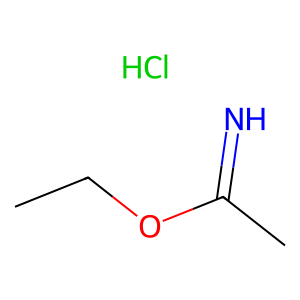 Cas:2208-07-3

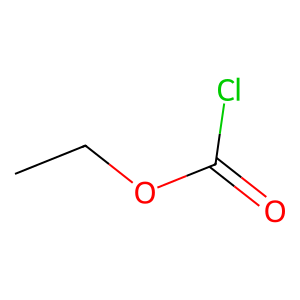 Cas:541-41-3

 Cas:60-35-5
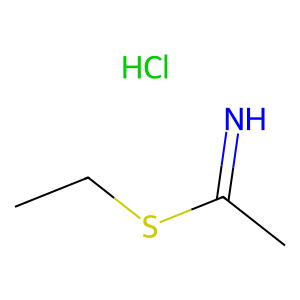 Cas:5426-05-1
 Cas:64-17-5