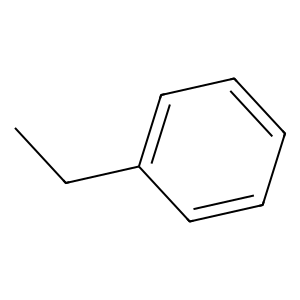
Ethylbenzene
CAS No.:
100-41-4
M. Wt:
106.165
M. Fa:
C8H10
InChI Key:
YNQLUTRBYVCPMQ-UHFFFAOYSA-N
Appearance:
Colorless liquid
Names and Identifiers of Ethylbenzene
CAS Number |
100-41-4 |
|---|---|
EC Number |
202-849-4 |
MDL Number |
MFCD00011647 |
IUPAC Name |
ethylbenzene |
InChI |
InChI=1S/C8H10/c1-2-8-6-4-3-5-7-8/h3-7H,2H2,1H3 |
InChIKey |
YNQLUTRBYVCPMQ-UHFFFAOYSA-N |
Canonical SMILES |
CCC1=CC=CC=C1 |
UNII |
L5I45M5G0O |
UNSPSC Code |
12352100 |
UN Number |
1175 |
Physical and chemical properties of Ethylbenzene
Boiling Point |
277 °F |
|---|---|
BRN |
1901871 |
carcinogen classification |
2B (Vol. 77) 2000 |
Decomposition |
When heated to decomposition it emits acrid smoke and irritating fumes. |
Density |
0.87 |
Exact Mass |
106.078247 |
explosive limit |
1.0-7.8%(V) |
Flash Point |
55 °F |
Freezing Point |
-95℃ |
Index of Refraction |
Index of refraction: 1.4959 at 20 °C/D |
LogP |
3.1 |
Melting Point |
-139 °F |
Merck |
14,3765 |
Molecular Formula |
C8H10 |
Molecular Weight |
106.165 |
Odor |
Sweet, gasoline-like odor |
Odor Threshold |
0.17ppm |
Solubility |
0.2g/L at 25°C in Water |
Stability |
Stable. Incompatible with oxidizing agents. Flammable. |
Storage condition |
Store below +30°C. |
Vapour density |
3.66 |
Vapour Pressure |
7 mmHg |
Water Solubility |
0.0206 g/100 mL |
Solubility of Ethylbenzene
| Solvent | Dissolution Behavior | Temperature Effect | pH Effect |
|---|---|---|---|
| Water | Slightly soluble, solubility approximately 150 mg/L (25°C) | Solubility increases slightly with rising temperature | pH has minimal effect on ethylbenzene solubility; as a nonpolar organic compound, it does not react with H⁺ or OH⁻, so solubility remains largely unchanged under acidic, neutral, or alkaline conditions |
| Ethanol | Freely soluble | Solubility further increases with rising temperature | No significant pH effect (ethanol is an organic solvent and the system does not have a typical pH concept) |
| Diethyl ether | Freely soluble | Increased temperature promotes mutual solubility | No pH effect |
| n-Hexane | Completely miscible | Almost unaffected by temperature, remains fully miscible at all temperatures | No pH effect |
| Acetone | Freely soluble | Higher temperature favors dissolution | No significant pH effect |
Safety Information of Ethylbenzene


Key Milestone of Ethylbenzene
| Time | Event | Background/Significance |
|---|---|---|
| 1839 | German chemist Eduard Mitscherlich first synthesized ethylbenzene by reacting benzene with chloroethane in the presence of aluminum chloride catalyst | The first artificial synthesis of ethylbenzene, marking the early exploration of aromatic hydrocarbon alkylation reactions and laying the foundation for the Friedel-Crafts reaction |
| 1877 | Charles Friedel and James Crafts systematically studied the alkylation and acylation reactions of aromatic hydrocarbons (i.e., the Friedel-Crafts reaction) | Provided a reliable method for the industrial synthesis of ethylbenzene, promoting its subsequent large-scale production |
| 1930s | Companies such as Standard Oil developed an industrial process for ethylbenzene synthesis using benzene and ethylene with acidic catalysts (such as AlCl₃) | Realized the large-scale production of ethylbenzene, meeting the growing demand for chemical raw materials |
| 1940s | Ethylbenzene became a key intermediate for the production of styrene | Styrene is a fundamental monomer for producing polyethylene, ABS resins, butyl rubber, and other polymer materials. Ethylbenzene became a core intermediate in the petrochemical industry chain |
| 1960s | Molecular sieve catalysts (such as ZSM-5) were developed for the synthesis of ethylbenzene, gradually replacing traditional AlCl₃ catalysts | Improved reaction selectivity, reduced corrosion and waste emissions, promoting the development of green chemistry |
| 1980s to present | The global annual production of ethylbenzene exceeds 40 million tons, mainly produced by the alkylation of benzene with ethylene, with over 90% used for styrene production | Became one of the most important organic chemical intermediates globally, supporting industries such as plastics, rubbers, and synthetic fibers |
| 1990s onwards | Various countries have strengthened occupational exposure limits and environmental regulations for ethylbenzene (e.g., the U.S. EPA listed it as a hazardous air pollutant) | Due to its potential carcinogenicity and volatility, it has promoted the development of safer production processes and emission control technologies |
Applications of Ethylbenzene
Ethylbenzene's primary application is as a precursor for styrene production, which is further processed into polystyrene. Other applications include:
- Solvent: Used in various industrial applications due to its solvent properties.
- Chemical Intermediate: Involved in producing other chemicals like ethylbenzene hydroperoxide.
- Fuel Additive: Sometimes used in fuel formulations due to its aromatic nature.
Biological Activity of Ethylbenzene
Ethylbenzene has been classified as a possible carcinogen by the International Agency for Research on Cancer (IARC), although the United States Environmental Protection Agency (EPA) has not classified it as such. Studies have indicated that exposure to ethylbenzene may increase the incidence of tumors in laboratory animals, particularly in the kidneys and lungs. Furthermore, it can cause irritation to the respiratory system and skin upon exposure.
Physical sample testing spectrum (NMR) of Ethylbenzene

 Cas:71-43-2
