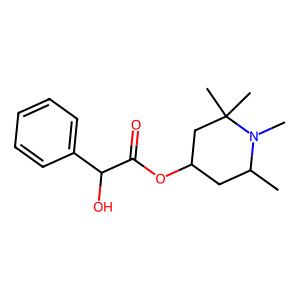
Eucatropine
Names and Identifiers of Eucatropine
CAS Number |
100-91-4 |
|---|---|
EC Number |
202-900-0 |
IUPAC Name |
(1,2,2,6-tetramethylpiperidin-4-yl) 2-hydroxy-2-phenylacetate |
InChI |
InChI=1S/C17H25NO3/c1-12-10-14(11-17(2,3)18(12)4)21-16(20)15(19)13-8-6-5-7-9-13/h5-9,12,14-15,19H,10-11H2,1-4H3 |
InChIKey |
QSAVEGSLJISCDF-UHFFFAOYSA-N |
Canonical SMILES |
CC1CC(CC(N1C)(C)C)OC(=O)C(C2=CC=CC=C2)O |
UNII |
4SPJ105W8E |
Physical and chemical properties of Eucatropine
Boiling Point |
388.7ºC at 760mmHg |
|---|---|
Density |
1.11g/cm3 |
Exact Mass |
291.18300 |
Flash Point |
188.8ºC |
LogP |
2.46240 |
Molecular Formula |
C17H25NO3 |
Molecular Weight |
291.38500 |
PSA |
49.77000 |
Vapour Pressure |
9.97E-08mmHg at 25°C |
Applications of Eucatropine
Eucatropine has several applications in medicine and research:
- Anticholinergic Agent: It is used to manage conditions associated with excessive cholinergic activity, such as bronchospasm and gastrointestinal disorders.
- Research Tool: Eucatropine serves as a valuable tool in pharmacological studies aimed at understanding muscarinic receptor functions and their implications in various diseases.
Interaction Studies of Eucatropine
Interaction studies involving Eucatropine have demonstrated its ability to bind selectively to muscarinic receptors. These studies often assess the compound's affinity (Ki values) across different receptor subtypes (M1, M2, M3) and analyze its pharmacokinetics and metabolism. For instance, Eucatropine has shown stability under physiological conditions, indicating potential for therapeutic use without rapid degradation.
Biological Activity of Eucatropine
Eucatropine exhibits significant biological activity as a muscarinic acetylcholine receptor antagonist. It has been shown to produce behavioral effects through central cholinoceptive sites in animal models, particularly in cats. Its antagonistic action on mAChRs contributes to its therapeutic effects, such as reducing secretions and muscle spasms associated with various conditions.