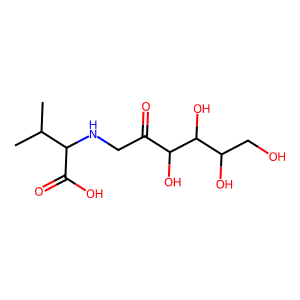
Fructosylvaline
CAS No.:
10003-64-2
M. Wt:
279.28700
M. Fa:
C11H21NO7
InChI Key:
JEQHVKBNRPNQDY-UTINFBMNSA-N
Appearance:
Off-white to pale yellow solid
Names and Identifiers of Fructosylvaline
CAS Number |
10003-64-2 |
|---|---|
IUPAC Name |
(2S)-3-methyl-2-[[(3S,4R,5R)-3,4,5,6-tetrahydroxy-2-oxohexyl]amino]butanoic acid |
InChI |
InChI=1S/C11H21NO7/c1-5(2)8(11(18)19)12-3-6(14)9(16)10(17)7(15)4-13/h5,7-10,12-13,15-17H,3-4H2,1-2H3,(H,18,19)/t7-,8+,9-,10-/m1/s1 |
InChIKey |
JEQHVKBNRPNQDY-UTINFBMNSA-N |
Canonical SMILES |
CC(C)C(C(=O)O)NCC(=O)C(C(C(CO)O)O)O |
Isomeric SMILES |
CC(C)[C@@H](C(=O)O)NCC(=O)[C@H]([C@@H]([C@@H](CO)O)O)O |
UNII |
H77T9T95MQ |
Physical and chemical properties of Fructosylvaline
Exact Mass |
279.13200 |
|---|---|
Melting Point |
112-114°C |
Molecular Formula |
C11H21NO7 |
Molecular Weight |
279.28700 |
PSA |
139.48000 |
Solubility |
Methanol (Slightly), Water (Slightly) |
Storage condition |
Refrigerator, Under Inert Atmosphere |
Applications of Fructosylvaline
Fructosylvaline has several applications across different fields:
- Biosensors: It is utilized in developing biosensors for detecting glycated proteins, particularly hemoglobin A1c, which is critical for diabetes management. For instance, gold nanostar-based sensors have been developed for colorimetric detection of fructosylvaline.
- Medical Diagnostics: As a marker for glycation, it aids in assessing long-term glucose control in diabetic patients.
- Research Tool: The compound serves as a substrate in biochemical assays aimed at understanding glycation processes and their implications in various diseases.
Interaction Studies of Fructosylvaline
Studies have shown that fructosylvaline interacts with various receptors and enzymes:
- Molecular Recognition: Research indicates that arylboronic acid-based receptors can selectively bind to fructosylvaline, highlighting its potential for use in supramolecular chemistry applications.
- Enzymatic Interactions: Fructosyl-amino acid oxidase specifically recognizes and acts on fructosylvaline, facilitating its oxidation and subsequent detection.
Biological Activity of Fructosylvaline
Fructosylvaline exhibits notable biological activities:
- Cellular Effects: It has been shown to alter cellular adhesion properties and may induce apoptosis in certain cancer cells, suggesting potential anti-cancer properties.
- Impact on Microorganisms: Certain microbial strains can utilize fructosylvaline as a nitrogen source, indicating its role in microbial metabolism.
- Glycation Marker: As a component of glycated hemoglobin, fructosylvaline serves as a biomarker for long-term glucose levels in diabetic patients, aiding in the management and diagnosis of diabetes.
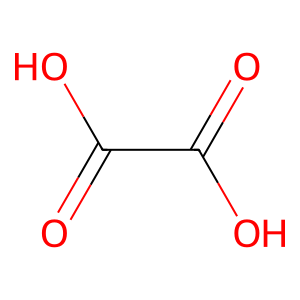 Cas:144-62-7

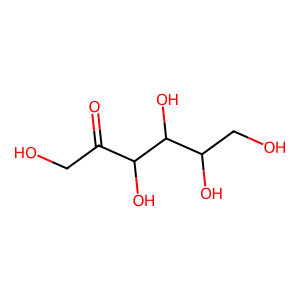 Cas:57-48-7
 Cas:67-56-1
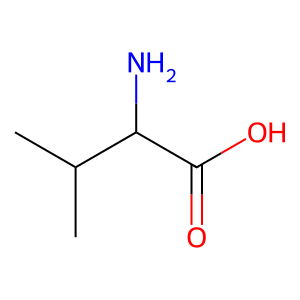 Cas:72-18-4

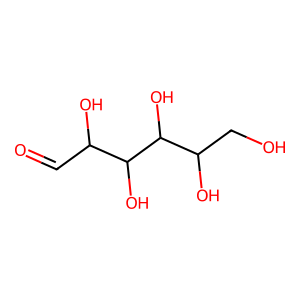 Cas:50-99-7