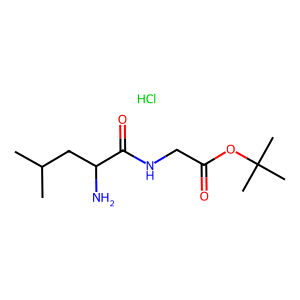
H-Leu-Gly-OtBu HCl
Names and Identifiers of H-Leu-Gly-OtBu HCl
CAS Number |
56610-13-0 |
|---|---|
IUPAC Name |
tert-butyl 2-[[(2S)-2-amino-4-methylpentanoyl]amino]acetate;hydrochloride |
InChI |
InChI=1S/C12H24N2O3.ClH/c1-8(2)6-9(13)11(16)14-7-10(15)17-12(3,4)5;/h8-9H,6-7,13H2,1-5H3,(H,14,16);1H/t9-;/m0./s1 |
InChIKey |
UTYHNRBLBHNQRL-FVGYRXGTSA-N |
Canonical SMILES |
CC(C)CC(C(=O)NCC(=O)OC(C)(C)C)N.Cl |
Isomeric SMILES |
CC(C)C[C@@H](C(=O)NCC(=O)OC(C)(C)C)N.Cl |
Physical and chemical properties of H-Leu-Gly-OtBu HCl
Exact Mass |
244.17900 |
|---|---|
LogP |
1.90890 |
Molecular Formula |
C12H24N2O3 |
Molecular Weight |
244.33100 |
PSA |
81.42000 |
Storage condition |
-15°C |
Applications of H-Leu-Gly-OtBu HCl
H-Leu-Gly-OtBu HCl has several notable applications:
- Pharmaceuticals: It serves as an intermediate in the synthesis of peptide-based drugs and supplements.
- Nutraceuticals: Due to its role in muscle metabolism, it is often included in dietary supplements aimed at athletes and bodybuilders.
- Research: It is used in biochemical studies investigating protein synthesis and metabolism pathways.
Interaction Studies of H-Leu-Gly-OtBu HCl
Interaction studies involving H-Leu-Gly-OtBu HCl focus on its behavior in biological systems and its interactions with other biomolecules. Research indicates that leucine derivatives can modulate signaling pathways related to muscle growth and metabolism. For instance, studies have shown that leucine can influence insulin signaling and glucose metabolism, suggesting potential implications for metabolic disorders.
Biological Activity of H-Leu-Gly-OtBu HCl
The biological activity of H-Leu-Gly-OtBu HCl is primarily linked to its leucine component, which is known for its role in protein synthesis and muscle metabolism. Leucine is an essential amino acid that stimulates muscle protein synthesis via the mTOR pathway. Additionally, it has potential applications in enhancing recovery from exercise and promoting muscle growth. The biological effects of this compound may also be influenced by the tert-butyl ester group, which can affect its solubility and bioavailability.
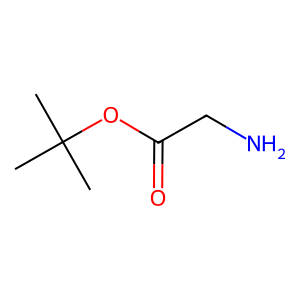 Cas:6456-74-2
