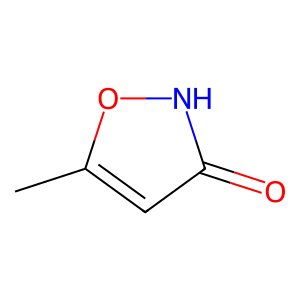
Hymexazol
Names and Identifiers of Hymexazol
CAS Number |
10004-44-1 |
|---|---|
EC Number |
233-000-6 |
MDL Number |
MFCD00144468 |
IUPAC Name |
5-methyl-1,2-oxazol-3-one |
InChI |
InChI=1S/C4H5NO2/c1-3-2-4(6)5-7-3/h2H,1H3,(H,5,6) |
InChIKey |
KGVPNLBXJKTABS-UHFFFAOYSA-N |
Canonical SMILES |
CC1=CC(=O)NO1 |
UNII |
20T2M875LO |
UNSPSC Code |
12352100 |
Physical and chemical properties of Hymexazol
Acidity coefficient |
5.91 (weak acid) |
|---|---|
Boiling Point |
228.2ºC at 760 mmHg |
Density |
1.185 g/cm3 |
Exact Mass |
198.064056 |
Flash Point |
91.8ºC |
Index of Refraction |
1.467 |
LogP |
0.27630 |
Melting Point |
80°C |
Merck |
14,4856 |
Molecular Formula |
C4H5NO2 |
Molecular Weight |
198.176 |
PSA |
46.00000 |
Sensitivity |
Light Sensitive |
Solubility |
Soluble in alcohol, acetone, THF, chloroform |
Storage condition |
2-8°C |
Vapour Pressure |
0.0493mmHg at 25°C |
Water Solubility |
65,100 mg l-1 (20 °C) |
Solubility of Hymexazol
| Solvent | Dissolution Behavior | Temperature Effect | pH Effect |
|---|---|---|---|
| Water | Slightly soluble, forms a clear solution | Increased temperature slightly improves solubility | Stable under neutral to weakly acidic conditions; prone to decomposition under strong alkaline conditions |
| Ethanol | Soluble, forms a transparent solution | Higher temperature significantly enhances dissolution rate and extent | Dissolves well under acidic or neutral conditions; may precipitate under alkaline conditions |
| Acetone | Freely soluble, completely dissolves with a clear solution | Dissolves more rapidly with increased temperature | Insensitive to pH changes, but may degrade under strong alkaline conditions |
| Methanol | Freely soluble, forms a clear solution | Increased temperature promotes dissolution | Good stability, especially under neutral conditions |
| Ethyl acetate | Slightly soluble to soluble (depending on concentration) | Heating improves solubility | Stable in acidic environments; may hydrolyze under alkaline conditions |
| Dichloromethane | Soluble, good solubility | Solubility increases with temperature | Essentially unaffected by pH |
| Chloroform | Soluble | Solubility increases with temperature | Stable under neutral conditions |
Safety Information of Hymexazol


Key Milestone of Hymexazol
| Time | Event | Description |
|---|---|---|
| 1963 | First synthesis | It was first synthesized by researchers at Sankyo Co., Ltd. in Japan, with the chemical name 3-hydroxy-5-methylisoxazole. |
| 1970 | Discovery of fungicidal activity | Research found that the compound has significant inhibitory effects on various soil-borne fungal pathogens, such as Fusarium, Pythium, and Rhizoctonia, especially effective against rice seedling blight. |
| 1974 | First registration and market launch in Japan | The compound was officially registered and launched as a agricultural fungicide in Japan, with trade names such as "Oxine", mainly used to control soil-borne diseases in rice, vegetables, etc. |
| 1970s–1980s | Expansion of application range | It was promoted and widely used in Asian countries such as China and South Korea, for the prevention and control of seedling blight, damping-off, and root rot in crops such as rice, vegetable seedbeds, flowers, and fruit trees. |
| 1980s | Deepened research on mechanism of action | Studies showed that the compound mainly inhibits the respiratory function and cell membrane function of pathogenic fungi, and also has systemic and growth-promoting properties, being absorbed by plant roots and translocated within the plant. |
| 1990s | Large-scale application in China | China introduced and achieved domestic production, becoming one of the key agents for controlling rice seedling blight, especially widely used in the northeast rice areas. |
| 2000s to present | Resistance management and combination use | To delay the development of resistance, the compound is often combined with other fungicides such as metalaxyl, thiram, and fludioxonil, to improve efficacy and broaden the spectrum of control. |
| Since 2010s | Improved environmental and toxicological evaluation | Many countries have re-evaluated its environmental behavior and toxicological characteristics, confirming it is low-toxic to mammals and degrades easily in soil, but still requires proper use to reduce ecological risks. |
Applications of Hymexazol
Hymexazol is primarily used as a fungicide in agriculture. Its applications include:
- Seed Treatment: Recommended dosages range from 10.5 to 14 grams per kilogram of seed to protect against soil-borne fungal infections.
- Soil Fungicide: It is effective against damping-off diseases in various crops.
- Research Tool: Due to its biological activity, hymexazol is also employed in experimental studies related to neurotoxicity and oxidative stress.
Interaction Studies of Hymexazol
Studies on hymexazol interactions reveal its potential neurotoxic effects when exposed to non-target organisms. In laboratory settings, hymexazol has been shown to increase levels of malondialdehyde (a marker of oxidative stress) while decreasing glutathione and catalase activity in brain tissues of exposed rats. These findings suggest that hymexazol may activate apoptosis pathways through oxidative stress mechanisms. Furthermore, its interaction with other environmental factors can influence its degradation and efficacy as a fungicide.
Biological Activity of Hymexazol
Hymexazol exhibits notable biological activity, particularly in its antifungal properties. It has been shown to disrupt the normal growth of various fungal pathogens by targeting specific metabolic pathways. Research indicates that hymexazol can induce neurotoxicity in certain animal models, highlighting its potential adverse effects on non-target organisms. The compound has been linked to oxidative stress and histopathological alterations in the brains of exposed rats. Furthermore, hymexazol's impact on melanin biosynthesis has been documented, indicating its broader biological implications beyond fungicidal activity.
Physical sample testing spectrum (NMR) of Hymexazol

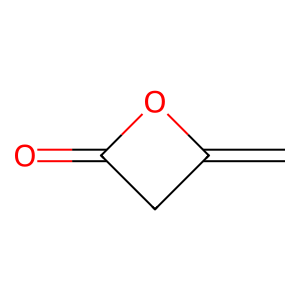 Cas:674-82-8

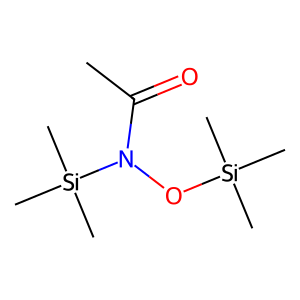 Cas:87318-59-0
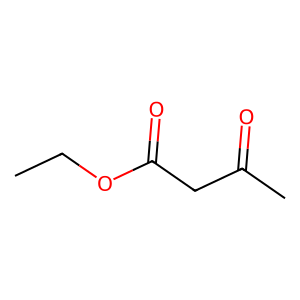 Cas:141-97-9