
Irinotecan hydrochloride
Names and Identifiers of Irinotecan hydrochloride
CAS Number |
100286-90-6 |
|---|---|
EC Number |
600-054-0 |
MDL Number |
MFCD01862255 |
IUPAC Name |
[(19S)-10,19-diethyl-19-hydroxy-14,18-dioxo-17-oxa-3,13-diazapentacyclo[11.8.0.02,11.04,9.015,20]henicosa-1(21),2,4(9),5,7,10,15(20)-heptaen-7-yl] 4-piperidin-1-ylpiperidine-1-carboxylate;hydrochloride |
InChI |
InChI=1S/C33H38N4O6.ClH/c1-3-22-23-16-21(43-32(40)36-14-10-20(11-15-36)35-12-6-5-7-13-35)8-9-27(23)34-29-24(22)18-37-28(29)17-26-25(30(37)38)19-42-31(39)33(26,41)4-2;/h8-9,16-17,20,41H,3-7,10-15,18-19H2,1-2H3;1H/t33-;/m0./s1 |
InChIKey |
GURKHSYORGJETM-WAQYZQTGSA-N |
Canonical SMILES |
CCC1=C2CN3C(=CC4=C(C3=O)COC(=O)C4(CC)O)C2=NC5=C1C=C(C=C5)OC(=O)N6CCC(CC6)N7CCCCC7.Cl |
Isomeric SMILES |
CCC1=C2CN3C(=CC4=C(C3=O)COC(=O)[C@@]4(CC)O)C2=NC5=C1C=C(C=C5)OC(=O)N6CCC(CC6)N7CCCCC7.Cl |
UNII |
06X131E4OE |
UNSPSC Code |
12352100 |
Physical and chemical properties of Irinotecan hydrochloride
Boiling Point |
257 °C |
|---|---|
Exact Mass |
622.255798 |
Flash Point |
482ºC |
Index of Refraction |
67.7 ° (C=1, H2O) |
LogP |
4.76890 |
Melting Point |
250-256°C (dec.) |
Merck |
5091 |
Molecular Formula |
C33H39ClN4O6 |
Molecular Weight |
623.139 |
PSA |
114.20000 |
Storage condition |
Refrigerator |
Vapour Pressure |
1.31E-32mmHg at 25°C |
Water Solubility |
Soluble in DMSO at 100mg/ml. Soluble in water at 25mg/ml with warming |
Safety Information of Irinotecan hydrochloride

Applications of Irinotecan hydrochloride
Irinotecan is predominantly used in chemotherapy regimens for:
- Colorectal Cancer: Often combined with other agents like 5-fluorouracil and leucovorin.
- Pancreatic Adenocarcinoma: Administered as part of multimodal treatment strategies.
- Other Cancers: Investigated for efficacy against lung and cervical cancers.
Interaction Studies of Irinotecan hydrochloride
Irinotecan exhibits various drug interactions that can influence its efficacy and safety profile:
- Cytochrome P450 Enzymes: Metabolized by CYP3A4 and CYP3A5; interactions with drugs that inhibit or induce these enzymes can alter irinotecan levels.
- Uridine Diphosphate Glucuronosyltransferases: Variability in UGT1A1 activity can lead to differences in toxicity among patients, especially those with genetic polymorphisms affecting enzyme function.
Adverse reactions commonly associated with irinotecan include severe diarrhea and neutropenia, necessitating careful monitoring during treatment.
Biological Activity of Irinotecan hydrochloride
Irinotecan exhibits significant biological activity as an antitumor agent by inhibiting DNA topoisomerase I. This inhibition prevents the religation of single-strand breaks in DNA, leading to double-strand breaks during DNA replication. The resultant DNA damage triggers apoptosis in cancer cells, effectively halting tumor growth.
The compound's pharmacokinetics reveal that it has a large volume of distribution (approximately 400 L/m²) and is primarily bound to plasma proteins like albumin, which helps stabilize its active form.
Physical sample testing spectrum (NMR) of Irinotecan hydrochloride

 Cas:97682-44-5

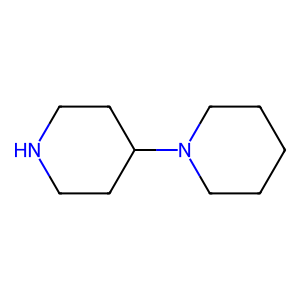 Cas:4897-50-1

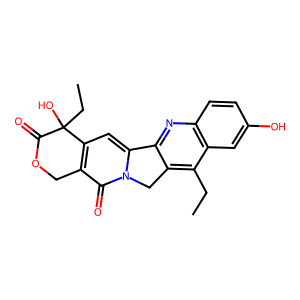 Cas:86639-52-3
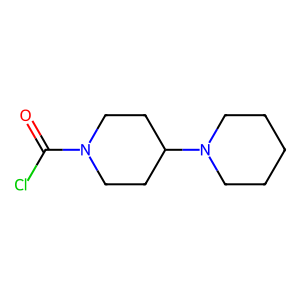 Cas:103816-19-9