
Lisofylline
CAS No.:
100324-81-0
M. Wt:
280.323
M. Fa:
C13H20N4O3
InChI Key:
NSMXQKNUPPXBRG-SECBINFHSA-N
Appearance:
White Solid
Names and Identifiers of Lisofylline
CAS Number |
100324-81-0 |
|---|---|
IUPAC Name |
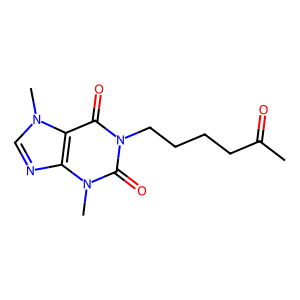
1-[(5R)-5-hydroxyhexyl]-3,7-dimethylpurine-2,6-dione |
InChI |
InChI=1S/C13H20N4O3/c1-9(18)6-4-5-7-17-12(19)10-11(14-8-15(10)2)16(3)13(17)20/h8-9,18H,4-7H2,1-3H3/t9-/m1/s1 |
InChIKey |
NSMXQKNUPPXBRG-SECBINFHSA-N |
Canonical SMILES |
CC(CCCCN1C(=O)C2=C(N=CN2C)N(C1=O)C)O |
Isomeric SMILES |
C[C@H](CCCCN1C(=O)C2=C(N=CN2C)N(C1=O)C)O |
UNII |
L1F2Q2X956 |
Physical and chemical properties of Lisofylline
Acidity coefficient |
15.22±0.20(Predicted) |
|---|---|
Boiling Point |
511.2±56.0 °C at 760 mmHg |
Density |
1.3±0.1 g/cm3 |
Exact Mass |
280.153534 |
Flash Point |
263.0±31.8 °C |
Index of Refraction |
1.621 |
LogP |
0.34 |
Melting Point |
105-107°C |
Molecular Formula |
C13H20N4O3 |
Molecular Weight |
280.323 |
PSA |
82.05000 |
Solubility |
Chloroform, Methanol |
Specific rotation |
D20 -5.6° (c = 6.7 in ethanol) |
Stability |
Hygroscopic |
Storage condition |
Hygroscopic, -20°C Freezer, Under Inert Atmosphere |
Vapour Pressure |
0.0±1.4 mmHg at 25°C |
Applications of Lisofylline
(R)-Lisofylline is primarily being researched for its potential applications in:
- Type 1 Diabetes Treatment: Its ability to prevent diabetes onset in preclinical models positions it as a promising therapeutic agent.
- Anti-inflammatory Therapy: Given its mechanism of action against inflammatory cytokines, it may also be beneficial in treating other inflammatory conditions.
- Mitochondrial Function Improvement: Its effects on cellular metabolism could open avenues for treating metabolic disorders associated with diabetes.
Biological Activity of Lisofylline
The biological activity of (R)-Lisofylline is primarily linked to its anti-inflammatory effects. It has been demonstrated to protect pancreatic β-cells from dysfunction induced by Th1 cytokines, which are often implicated in autoimmune damage associated with Type 1 Diabetes. Additionally, (R)-Lisofylline enhances mitochondrial function in cells and improves the viability of isolated or transplanted pancreatic islets, making it a candidate for diabetes treatment.
Physical sample testing spectrum (NMR) of Lisofylline

 Cas:6493-05-6

 Cas:83-67-0