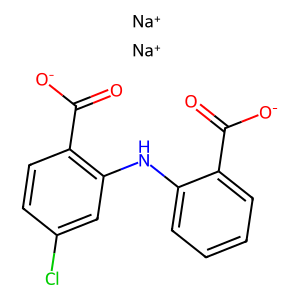
Lobenzarit sodium
Names and Identifiers of Lobenzarit sodium
CAS Number |
64808-48-6 |
|---|---|
EC Number |
811-076-7 |
IUPAC Name |
disodium;2-(2-carboxylatoanilino)-4-chlorobenzoate |
InChI |
InChI=1S/C14H10ClNO4.2Na/c15-8-5-6-10(14(19)20)12(7-8)16-11-4-2-1-3-9(11)13(17)18;;/h1-7,16H,(H,17,18)(H,19,20);;/q;2*+1/p-2 |
InChIKey |
QPJBONAWFAURGB-UHFFFAOYSA-L |
Canonical SMILES |
C1=CC=C(C(=C1)C(=O)[O-])NC2=C(C=CC(=C2)Cl)C(=O)[O-].[Na+].[Na+] |
UNII |
7Z9SP74BXF |
Physical and chemical properties of Lobenzarit sodium
Boiling Point |
481ºC at 760 mmHg |
|---|---|
Exact Mass |
334.993713 |
Flash Point |
244.7ºC |
LogP |
0.88360 |
Melting Point |
388 °C(dec.) |
Merck |
14,5552 |
Molecular Formula |
C14H8ClNNa2O4 |
Molecular Weight |
335.65 |
PSA |
92.29000 |
Water Solubility |
Soluble in water |
Safety Information of Lobenzarit sodium

Applications of Lobenzarit sodium
Lobenzarit sodium is primarily used as an anti-arthritic agent, helping alleviate symptoms associated with rheumatoid arthritis. Its immunomodulatory properties make it a candidate for treating autoimmune diseases where modulation of immune response is beneficial. Additionally, it has shown potential as an antioxidant, which could be advantageous in conditions characterized by oxidative stress .
Interaction Studies of Lobenzarit sodium
Studies have indicated that lobenzarit sodium interacts with various cellular pathways and immune cell types. It does not inhibit the biosynthesis of prostaglandins or leukotrienes, suggesting that its anti-inflammatory effects are mediated through different mechanisms than those employed by non-steroidal anti-inflammatory drugs . Furthermore, it has been shown to activate suppressor T lymphocytes, enhancing their activity in regulating immune responses .
Biological Activity of Lobenzarit sodium
The biological activity of lobenzarit sodium can be attributed to its effects on different immune cell types. It has been shown to enhance the ratio of suppressor T cells to helper T cells, which is vital for regulating immune responses. In murine models, lobenzarit sodium has demonstrated the ability to reduce immunoglobulin E antibody responses, indicating its potential in managing allergic reactions . Moreover, it inhibits the proliferative response of human endothelial cells and reduces the expression of HLA-DR antigens on their surface, which are markers associated with immune activation .