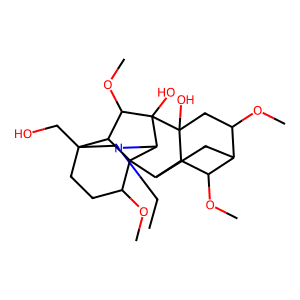
Lycoctonine
CAS No.:
26000-17-9
M. Wt:
467.59600
M. Fa:
C25H41NO7
InChI Key:
YOTUXHIWBVZAJQ-UHFFFAOYSA-N
Names and Identifiers of Lycoctonine
CAS Number |
26000-17-9 |
|---|---|
IUPAC Name |
11-ethyl-13-(hydroxymethyl)-4,6,16,18-tetramethoxy-11-azahexacyclo[7.7.2.12,5.01,10.03,8.013,17]nonadecane-8,9-diol |
InChI |
InChI=1S/C25H41NO7/c1-6-26-11-22(12-27)8-7-16(31-3)24-14-9-13-15(30-2)10-23(28,17(14)18(13)32-4)25(29,21(24)26)20(33-5)19(22)24/h13-21,27-29H,6-12H2,1-5H3 |
InChIKey |
YOTUXHIWBVZAJQ-UHFFFAOYSA-N |
Canonical SMILES |
CCN1CC2(CCC(C34C2C(C(C31)(C5(CC(C6CC4C5C6OC)OC)O)O)OC)OC)CO |
Physical and chemical properties of Lycoctonine
Acidity coefficient |
12.30±0.70(Predicted) |
|---|---|
Boiling Point |
578.8ºC at 760mmHg |
Density |
1.31g/cm3 |
Exact Mass |
467.28800 |
Flash Point |
303.8ºC |
Index of Refraction |
1.595 |
LogP |
0.20890 |
Melting Point |
143 °C |
Molecular Formula |
C25H41NO7 |
Molecular Weight |
467.59600 |
PSA |
100.85000 |
Specific rotation |
D20 +53° (ethanol) |
Vapour Pressure |
8.31E-16mmHg at 25°C |
Applications of Lycoctonine
Lycoctonine has several potential applications:
- Pharmaceutical Development: Its antimicrobial and cytotoxic properties make it a candidate for drug development against infections and cancer.
- Research Tool: Lycoctonine serves as a valuable compound in pharmacological research to study the mechanisms of action of alkaloids.
- Traditional Medicine: In some cultures, plants containing lycoctonine have been used in traditional medicine for their therapeutic properties.
Interaction Studies of Lycoctonine
Research on the interactions of lycoctonine with other compounds is limited but suggests interesting possibilities:
- Synergistic Effects: Preliminary studies indicate that when combined with other alkaloids or compounds, lycoctonine may enhance their biological activities.
- Mechanism of Action: Investigations into how lycoctonine interacts with cellular targets can provide insights into its pharmacological effects.
Biological Activity of Lycoctonine
Lycoctonine exhibits a range of biological activities that contribute to its pharmacological potential:
- Antimicrobial Properties: Studies indicate that lycoctonine has antimicrobial effects against certain bacterial strains, making it a candidate for further research in antibiotic development.
- Cytotoxicity: It has shown cytotoxic effects in various cancer cell lines, suggesting potential applications in cancer therapy.
- Neuroprotective Effects: Some research indicates that lycoctonine may offer neuroprotective benefits, although further studies are needed to clarify these effects.