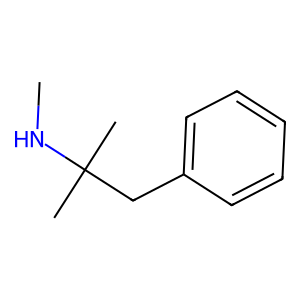
Mephentermine
CAS No.:
100-92-5
M. Wt:
163.25900
M. Fa:
C11H17N
InChI Key:
RXQCGGRTAILOIN-UHFFFAOYSA-N
Names and Identifiers of Mephentermine
CAS Number |
100-92-5 |
|---|---|
EC Number |
202-901-6 |
IUPAC Name |
N,2-dimethyl-1-phenylpropan-2-amine |
InChI |
InChI=1S/C11H17N/c1-11(2,12-3)9-10-7-5-4-6-8-10/h4-8,12H,9H2,1-3H3 |
InChIKey |
RXQCGGRTAILOIN-UHFFFAOYSA-N |
Canonical SMILES |
CC(C)(CC1=CC=CC=C1)NC |
UNII |
TEZ91L71V4 |
Physical and chemical properties of Mephentermine
Boiling Point |
229.4ºC at 760mmHg |
|---|---|
Density |
0.903g/cm3 |
Exact Mass |
163.13600 |
Flash Point |
90ºC |
Index of Refraction |
1.501 |
LogP |
2.61800 |
Melting Point |
< 25 °C |
Molecular Formula |
C11H17N |
Molecular Weight |
163.25900 |
Odor |
FISHY AMINE ODOR |
pH |
ALKALINE REACTION |
PSA |
12.03000 |
Solubility |
4.57e-01 g/L |
Vapour Pressure |
0.0697mmHg at 25°C |
Safety Information of Mephentermine

Applications of Mephentermine
Mephentermine has been primarily utilized in clinical settings for:
- Management of Hypotension: Especially during spinal anesthesia or surgical interventions.
- Cardiac Stimulation: Used in treating heart failure due to its positive inotropic effects.
Despite its therapeutic uses, mephentermine has seen a decline in marketing due to safety concerns and the availability of alternative agents.
Interaction Studies of Mephentermine
Mephentermine interacts with various pharmacological agents, which can enhance or diminish its effects:
- CNS Stimulants: May lead to increased central nervous system stimulation.
- Antihypertensives: Antagonizes the effects of medications that lower blood pressure.
- Monoamine Oxidase Inhibitors (MAOIs): Can cause severe hypertension when combined.
These interactions necessitate careful monitoring when mephentermine is administered alongside other medications.
Biological Activity of Mephentermine
Mephentermine exhibits significant biological activity as an adrenergic agonist. Its pharmacological effects include:
- Vasoconstriction: Increases peripheral vascular resistance.
- Positive Inotropic Effect: Enhances myocardial contractility.
- Sympathomimetic Effects: Induces release of norepinephrine and dopamine, contributing to increased heart rate and blood pressure.
The onset of action varies depending on the route of administration, with intramuscular injections taking 5 to 15 minutes for effect, while intravenous administration acts immediately.
 Cas:122-09-8

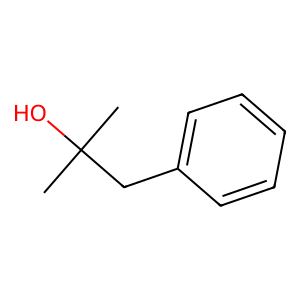 Cas:100-86-7

 Cas:143-33-9
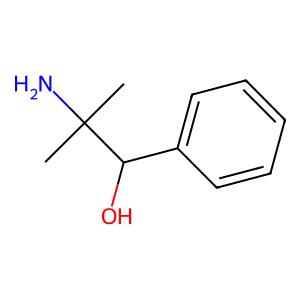 Cas:34405-42-0