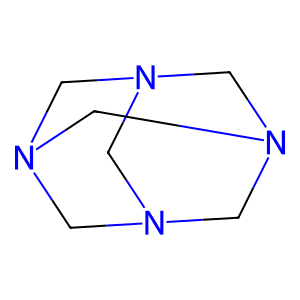
Methenamine
CAS No.:
100-97-0
M. Wt:
-
M. Fa:
-
InChI Key:
VKYKSIONXSXAKP-UHFFFAOYSA-N
Appearance:
White granular powder
Names and Identifiers of Methenamine
CAS Number |
100-97-0 |
|---|---|
EC Number |
202-905-8 |
IUPAC Name |
1,3,5,7-tetrazatricyclo[3.3.1.13,7]decane |
InChI |
InChI=1S/C6H12N4/c1-7-2-9-4-8(1)5-10(3-7)6-9/h1-6H2 |
InChIKey |
VKYKSIONXSXAKP-UHFFFAOYSA-N |
Canonical SMILES |
C1N2CN3CN1CN(C2)C3 |
UNII |
J50OIX95QV |
UN Number |
1328 |
Physical and chemical properties of Methenamine
Boiling Point |
Sublimes (NTP, 1992) |
|---|---|
Decomposition |
Decomposes on heating and on burning. This produces toxic and corrosive gases including formaldehyde, ammonia, hydrogen cyanide and nitrogen oxides. |
Density |
1.33 g/cm³ |
Flash Point |
250 °C c.c. |
Index of Refraction |
Index of refraction: 1.5911 at 25 °C |
LogP |
-2.84 |
Melting Point |
> 250 °C |
Odor |
Practically odorless |
pH |
pH of 0.2 molar aqueous solution: 8.4 |
Stability |
Stable under recommended storage conditions. |
Vapour density |
Relative vapor density (air = 1): 4.9 |
Vapour Pressure |
6.1X10⁻⁴ mm Hg at 25 °C |
Solubility of Methenamine
| Solvent | Dissolution Behavior | Temperature Effect | pH Effect |
|---|---|---|---|
| Water | Soluble, slight exothermic reaction may occur during dissolution | Solubility increases with rising temperature | Decomposes easily under acidic conditions, releasing formaldehyde and ammonia |
| Ethanol | Slightly soluble | Solubility slightly improves with increasing temperature | Minimal pH influence |
| Acetone | Insoluble | Almost insoluble, temperature has little effect | No significant pH effect |
| Chloroform | Insoluble | Completely insoluble | No noticeable effect |
| Ethyl acetate | Insoluble | Essentially insoluble | No noticeable effect |
| Strong acids (e.g., hydrochloric acid) | Reacts and decomposes, releasing formaldehyde and ammonium ions | Decomposition reaction accelerates with increasing temperature | Strongly acidic environment promotes decomposition |
| Strong bases (e.g., NaOH) | Reacts and decomposes, releasing ammonia and formaldehyde | Decomposition accelerates under alkaline conditions | High pH promotes decomposition reaction |
PPB grade of Methenamine
| Test Item | Technical Requirements |
|---|---|
| Appearance | White crystalline powder, free of visible foreign matter |
| Assay (HPLC or Titration) | ≥99.9% |
| Moisture (Karl Fischer) | ≤0.1% |
| Residue on Ignition (Sulfated Ash) | ≤5 ppm |
| Heavy Metals (as Pb) | ≤5 ppb |
| Iron (Fe) | ≤5 ppb |
| Chloride Ion (Cl⁻) | ≤10 ppb |
| Sulfate (SO₄²⁻) | ≤10 ppb |
| Ammonium Ion (NH₄⁺) | ≤50 ppb |
| Total Organic Carbon (TOC) | ≤50 ppb |
| Particulates (≥0.5 μm) | ≤100 particles/mL (in solution, e.g., 1% aqueous solution) |
| Bacterial Endotoxins | ≤0.05 EU/mg (if intended for pharmaceutical use) |
| Residual Solvents (e.g., Methanol) | ≤10 ppm (if solvent crystallization process is involved) |
| PPB-Level Specific Impurities (e.g., degradation products such as formaldehyde, ammonia) | Individual impurity ≤10 ppb, Total impurities ≤30 ppb |
Safety Information of Methenamine


Key Milestone of Methenamine
| Time | Event | Description |
|---|---|---|
| 1859 | First Synthesis | Russian chemist Alexander Butlerov first synthesized hexamethylenetetramine while studying the reaction of formaldehyde with ammonia and determined its chemical formula as (CH₂)₆N₄. |
| 1890s | Exploration of Medical Applications | Began to be studied for treating urinary tract infections, as it can slowly release formaldehyde in acidic urine, exhibiting antibacterial effects. |
| 1910 | Official Medical Use | Hexamethylenetetramine (under brand names such as Urotropin) was widely used clinically as a urinary antibacterial agent, particularly as an adjunctive treatment for conditions like chronic cystitis. |
| World War I (1914–1918) | Military Application | Used as a precursor for producing the explosive RDX (cyclotrimethylenetrinitramine). The reaction of hexamethylenetetramine with concentrated nitric acid yields RDX, making it an important raw material for military high-energy explosives. |
| 1930s–1940s | Expansion of Industrial Uses | Widely applied in fields such as phenolic resins, rubber vulcanization accelerators, and textile finishing agents, serving as a cross-linking agent and stabilizer. |
| 1940s | Large-Scale RDX Production | During World War II, hexamethylenetetramine became a key raw material for the Allies' large-scale production of RDX explosives, driving the development of its industrial synthesis technology. |
| 1950s–1970s | Food and Preservative Applications (Later Restricted) | Once used as a food preservative (particularly in some countries for fish products), but its use in food was subsequently banned or strictly restricted in most countries due to potential risks associated with formaldehyde release. |
| 1980s to Present | Changes in Medical Status | With the emergence of safer and more effective antibiotics, the role of hexamethylenetetramine in treating urinary system infections declined, though it remains in use as an auxiliary medication in some regions. |
| 21st Century | Emerging Research and Environmental Concerns | Exploration of its applications in areas such as nanomaterial synthesis, controlled-release formaldehyde systems, and antibacterial coatings; simultaneously, its decomposition to release formaldehyde has led to ongoing regulatory attention regarding environmental and health risks. |
Applications of Methenamine
Methenamine has diverse applications across various fields:
- Medical Use: Primarily used as an antiseptic for treating urinary tract infections due to its ability to release formaldehyde in acidic urine.
- Industrial Use: Employed in the production of phenolic resins and as a hardening agent in various materials such as brake linings and adhesives.
- Food Additive: Approved in some regions as a preservative (E239) for food products.
- Fuel Tablets: Utilized in solid fuel tablets for camping and military rations due to its high energy density and smokeless combustion properties.
Interaction Studies of Methenamine
Methenamine interacts with various drugs and substances. For instance, its combination with certain medications can alter their efficacy; for example, it may decrease the serum concentration of Phentermine when co-administered. Additionally, methenamine's antibacterial action can be inhibited by alkaline conditions or by bacteria that produce urease, which raises urine pH.
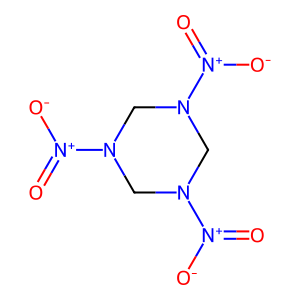 Cas:121-82-4

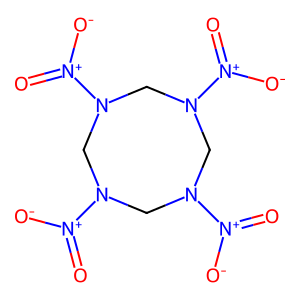 Cas:2691-41-0
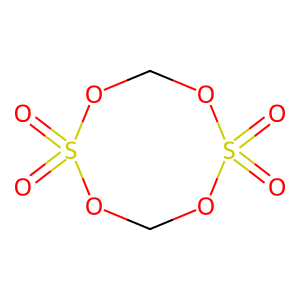 Cas:20757-83-9

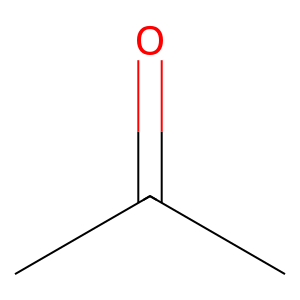 Cas:67-64-1
 Cas:7664-41-7