
Methyl 4-methyl-1-naphthoate
Names and Identifiers of Methyl 4-methyl-1-naphthoate
CAS Number |
35615-98-6 |
|---|---|
MDL Number |
MFCD06203861 |
IUPAC Name |
methyl 4-methylnaphthalene-1-carboxylate |
InChI |
InChI=1S/C13H12O2/c1-9-7-8-12(13(14)15-2)11-6-4-3-5-10(9)11/h3-8H,1-2H3 |
InChIKey |
LPLYJJXZWSVXHW-UHFFFAOYSA-N |
Canonical SMILES |
CC1=CC=C(C2=CC=CC=C12)C(=O)OC |
UNSPSC Code |
12352100 |
Physical and chemical properties of Methyl 4-methyl-1-naphthoate
Boiling Point |
323.7±11.0 °C(Predicted) |
|---|---|
Density |
1.126±0.06 g/cm3(Predicted) |
Exact Mass |
200.08400 |
LogP |
2.93480 |
Molecular Formula |
C13H12O2 |
Molecular Weight |
200.23300 |
PSA |
26.30000 |
Safety Information of Methyl 4-methyl-1-naphthoate

Applications of Methyl 4-methyl-1-naphthoate
Methyl 4-methyl-1-naphthoate finds applications in several areas:
- Organic Synthesis: It serves as an intermediate in the synthesis of various organic compounds, particularly those involving naphthalene derivatives.
- Pharmaceuticals: Due to its interactions with cytochrome P450 enzymes, it is of interest in drug metabolism studies, potentially aiding in the development of new pharmaceuticals.
- Material Science: The compound's unique properties may be leveraged in developing new materials or chemical sensors.
Interaction Studies of Methyl 4-methyl-1-naphthoate
Research indicates that methyl 4-methyl-1-naphthoate can bind to active sites of enzymes, leading to alterations in their catalytic activities. Its ability to modulate cytochrome P450 enzymes suggests it could significantly influence drug metabolism and biochemical pathways. Furthermore, its interaction with proteins through hydrogen bonding may affect protein structure and function, making it a valuable compound for further biological studies.
Biological Activity of Methyl 4-methyl-1-naphthoate
Methyl 4-methyl-1-naphthoate exhibits significant biological activity. Studies suggest that it interacts with various enzymes, particularly cytochrome P450 enzymes, which are crucial for drug metabolism. Its interactions can either inhibit or activate these enzymes, potentially influencing metabolic pathways and affecting drug efficacy and toxicity. Additionally, the compound may interact with DNA and RNA, impacting gene expression through mechanisms such as hydrogen bonding and hydrophobic interactions.
 Cas:186581-53-3

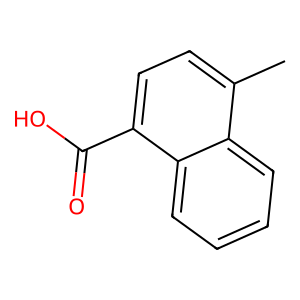 Cas:4488-40-8

 Cas:67-56-1