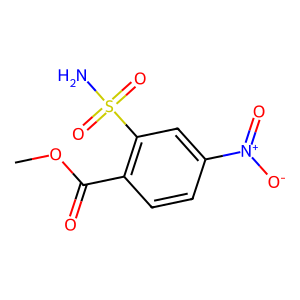
Methyl 4-nitro-2-sulfamoylbenzoate
Names and Identifiers of Methyl 4-nitro-2-sulfamoylbenzoate
CAS Number |
2297-01-0 |
|---|---|
MDL Number |
MFCD00443173 |
IUPAC Name |
methyl 4-nitro-2-sulfamoylbenzoate |
InChI |
InChI=1S/C8H8N2O6S/c1-16-8(11)6-3-2-5(10(12)13)4-7(6)17(9,14)15/h2-4H,1H3,(H2,9,14,15) |
InChIKey |
CRMWXYZOQXJLQI-UHFFFAOYSA-N |
Canonical SMILES |
COC(=O)C1=C(C=C(C=C1)[N+](=O)[O-])S(=O)(=O)N |
UNSPSC Code |
12352100 |
Physical and chemical properties of Methyl 4-nitro-2-sulfamoylbenzoate
Acidity coefficient |
9.04±0.60(Predicted) |
|---|---|
Boiling Point |
503.3±60.0 °C at 760 mmHg |
Density |
1.5±0.1 g/cm3 |
Exact Mass |
260.010315 |
Flash Point |
258.2±32.9 °C |
Index of Refraction |
1.585 |
LogP |
0.40 |
Melting Point |
191 °C |
Molecular Formula |
C8H8N2O6S |
Molecular Weight |
260.224 |
Storage condition |
2-8°C |
Vapour Pressure |
0.0±1.3 mmHg at 25°C |
Safety Information of Methyl 4-nitro-2-sulfamoylbenzoate

Applications of Methyl 4-nitro-2-sulfamoylbenzoate
Methyl 4-nitro-2-sulfamoylbenzoate has potential applications in:
- Pharmaceuticals: As a building block for synthesizing more complex sulfonamide drugs.
- Agricultural Chemistry: It may serve as an intermediate in developing herbicides or pesticides due to its structural properties.
- Biochemical Research: Used in studies related to enzyme inhibition and drug design.
Interaction Studies of Methyl 4-nitro-2-sulfamoylbenzoate
Studies on methyl 4-nitro-2-sulfamoylbenzoate's interactions have focused on its binding affinity to various biological targets, including enzymes and receptors. Its structural features suggest potential interactions with carbonic anhydrases and other sulfonamide-sensitive enzymes. In vitro studies have shown promising results regarding its inhibitory effects on these targets, warranting further investigation into its pharmacological profile.
Biological Activity of Methyl 4-nitro-2-sulfamoylbenzoate
Methyl 4-nitro-2-sulfamoylbenzoate exhibits potential biological activity, particularly in the field of medicinal chemistry. Sulfonamide compounds are known for their antibacterial properties, and derivatives like this one may also exhibit anti-inflammatory and antitumor activities. Research indicates that compounds with similar structures can inhibit certain enzymes involved in bacterial growth and proliferation.