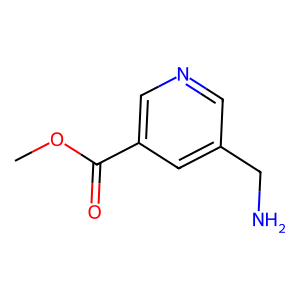
Methyl 5-(aminomethyl)nicotinate
Names and Identifiers of Methyl 5-(aminomethyl)nicotinate
CAS Number |
1001756-84-8 |
|---|---|
MDL Number |
MFCD11044538 |
IUPAC Name |
methyl 5-(aminomethyl)pyridine-3-carboxylate |
InChI |
InChI=1S/C8H10N2O2/c1-12-8(11)7-2-6(3-9)4-10-5-7/h2,4-5H,3,9H2,1H3 |
InChIKey |
ZQWJKAICQACUJX-UHFFFAOYSA-N |
Canonical SMILES |
COC(=O)C1=CN=CC(=C1)CN |
UNSPSC Code |
12352100 |
Physical and chemical properties of Methyl 5-(aminomethyl)nicotinate
Acidity coefficient |
7.91±0.29(Predicted) |
|---|---|
Boiling Point |
297.2±30.0 °C at 760 mmHg |
Density |
1.2±0.1 g/cm3 |
Exact Mass |
166.074234 |
Flash Point |
133.6±24.6 °C |
Index of Refraction |
1.547 |
LogP |
-0.25 |
Molecular Formula |
C8H10N2O2 |
Molecular Weight |
166.177 |
PSA |
65.21000 |
Storage condition |
under inert gas (nitrogen or Argon) at 2–8 °C |
Vapour Pressure |
0.0±0.6 mmHg at 25°C |
Safety Information of Methyl 5-(aminomethyl)nicotinate

Applications of Methyl 5-(aminomethyl)nicotinate
Methyl 5-(aminomethyl)nicotinate has diverse applications across several fields:
- Medicinal Chemistry: Ongoing research explores its potential use in drug development for conditions related to inflammation and microbial infections.
- Biological Research: It serves as a building block for synthesizing more complex molecules and studying biochemical pathways involving nicotinic compounds.
- Industrial Use: The compound may also find applications in various industrial processes due to its unique chemical properties.
Interaction Studies of Methyl 5-(aminomethyl)nicotinate
Interaction studies involving Methyl 5-(aminomethyl)nicotinate focus on understanding how this compound can be effectively utilized in therapeutic contexts. These studies are crucial for elucidating its mechanisms of action and potential interactions with biological targets, particularly in relation to its antimicrobial and anti-inflammatory effects.
Biological Activity of Methyl 5-(aminomethyl)nicotinate
Research indicates that Methyl 5-(aminomethyl)nicotinate exhibits various biological activities. Notably, it has been studied for its potential antimicrobial and anti-inflammatory properties. Its parent compound, methyl nicotinate, is known for acting as a peripheral vasodilator, which enhances local blood flow at the site of application. This mechanism may be relevant for therapeutic applications in treating inflammation and microbial infections.
Physical sample testing spectrum (NMR) of Methyl 5-(aminomethyl)nicotinate
