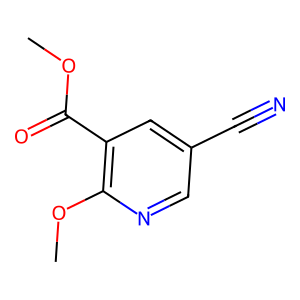
Methyl 5-cyano-2-methoxynicotinate
CAS No.:
1806320-48-8
M. Wt:
192.17
M. Fa:
C9H8N2O3
InChI Key:
JBYRVTZGMZMMMA-UHFFFAOYSA-N
Names and Identifiers of Methyl 5-cyano-2-methoxynicotinate
CAS Number |
1806320-48-8 |
|---|---|
MDL Number |
MFCD22371018 |
IUPAC Name |
methyl 5-cyano-2-methoxypyridine-3-carboxylate |
InChI |
InChI=1S/C9H8N2O3/c1-13-8-7(9(12)14-2)3-6(4-10)5-11-8/h3,5H,1-2H3 |
InChIKey |
JBYRVTZGMZMMMA-UHFFFAOYSA-N |
Canonical SMILES |
COC1=C(C=C(C=N1)C#N)C(=O)OC |
UNSPSC Code |
12352100 |
Physical and chemical properties of Methyl 5-cyano-2-methoxynicotinate
Boiling Point |
311.0±42.0 °C at 760 mmHg |
|---|---|
Density |
1.3±0.1 g/cm3 |
Exact Mass |
192.053497 |
Flash Point |
141.9±27.9 °C |
Index of Refraction |
1.528 |
LogP |
1.67 |
Molecular Formula |
C9H8N2O3 |
Molecular Weight |
192.17 |
Vapour Pressure |
0.0±0.7 mmHg at 25°C |
Safety Information of Methyl 5-cyano-2-methoxynicotinate

Applications of Methyl 5-cyano-2-methoxynicotinate
Methyl 5-cyano-2-methoxynicotinate has several applications, particularly in:
- Pharmaceutical Development: Its unique structure makes it a candidate for drug development, especially in creating novel therapeutic agents.
- Agricultural Chemicals: Potential use as a pesticide or herbicide due to its biological activity.
- Organic Synthesis: It serves as an intermediate in synthesizing more complex organic molecules.
Interaction Studies of Methyl 5-cyano-2-methoxynicotinate
Interaction studies involving methyl 5-cyano-2-methoxynicotinate focus on its behavior in biological systems and its interactions with various biomolecules. Key findings include:
- Enzyme Inhibition: It may inhibit certain enzymes, which could be beneficial for therapeutic applications.
- Binding Affinity Studies: Research into its binding affinity with proteins or receptors can provide insights into its mechanism of action and potential therapeutic uses.
Biological Activity of Methyl 5-cyano-2-methoxynicotinate
Research indicates that methyl 5-cyano-2-methoxynicotinate exhibits notable biological activities, including:
- Antimicrobial Properties: Preliminary studies suggest it has potential as an antimicrobial agent.
- Antioxidant Activity: The compound may exhibit antioxidant properties, contributing to cellular protection against oxidative stress.
- Potential Anti-inflammatory Effects: Some derivatives of nicotinic acid have shown anti-inflammatory properties, which may extend to this compound.