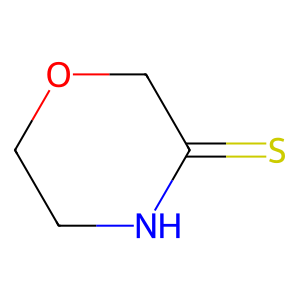
Morpholine-3-thione
CAS No.:
21009-57-4
M. Wt:
117.16900
M. Fa:
C4H7NOS
InChI Key:
LTAFRIZVOKDEMU-UHFFFAOYSA-N
Names and Identifiers of Morpholine-3-thione
CAS Number |
21009-57-4 |
|---|---|
IUPAC Name |
morpholine-3-thione |
InChI |
InChI=1S/C4H7NOS/c7-4-3-6-2-1-5-4/h1-3H2,(H,5,7) |
InChIKey |
LTAFRIZVOKDEMU-UHFFFAOYSA-N |
Canonical SMILES |
C1COCC(=S)N1 |
Physical and chemical properties of Morpholine-3-thione
Exact Mass |
117.02500 |
|---|---|
Molecular Formula |
C4H7NOS |
Molecular Weight |
117.16900 |
PSA |
60.39000 |
Applications of Morpholine-3-thione
Morpholine-3-thione finds applications across various fields:
- Pharmaceuticals: It serves as a precursor for synthesizing drugs with antimicrobial and anticancer properties.
- Agricultural Chemicals: Derivatives are used as fungicides due to their ability to inhibit fungal growth.
- Chemical Synthesis: Morpholine-3-thione acts as a building block in organic synthesis, facilitating the creation of more complex molecules.
These applications demonstrate the compound's versatility and importance in both research and industry.
Interaction Studies of Morpholine-3-thione
Interaction studies involving morpholine-3-thione have revealed its binding characteristics with biological macromolecules:
- Binding Affinity: Research indicates that morpholine-3-thione derivatives can interact with enzyme active sites through hydrogen bonding and hydrophobic interactions, enhancing their efficacy as enzyme inhibitors.
- Molecular Docking Studies: Computational studies have shown how these compounds fit into enzyme active sites, providing insights into their mechanism of action and potential modifications for improved activity.
These studies are crucial for understanding how morpholine-3-thione can be optimized for therapeutic use.
Biological Activity of Morpholine-3-thione
Morpholine-3-thione exhibits notable biological activities, particularly in medicinal chemistry:
- Antimicrobial Activity: Various derivatives of morpholine-3-thione have shown promise as antimicrobial agents against a range of pathogens.
- Anticancer Properties: Some studies indicate that morpholine-3-thione derivatives possess cytotoxic effects against cancer cell lines, suggesting potential applications in cancer therapy.
- Enzyme Inhibition: Compounds derived from morpholine-3-thione have been investigated for their ability to inhibit specific enzymes, including urease, which is relevant for treating infections caused by urease-producing bacteria.
These biological activities make morpholine-3-thione a valuable compound for further research and development in pharmaceuticals.