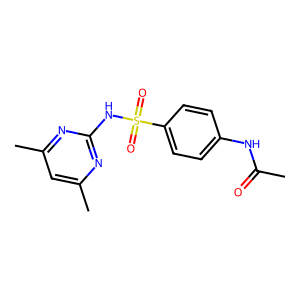
N(4)-Acetylsulfamethazine
CAS No.:
100-90-3
M. Wt:
320.36700
M. Fa:
C14H16N4O3S
InChI Key:
LJKAKWDUZRJNPJ-UHFFFAOYSA-N
Appearance:
Off-white solid
Names and Identifiers of N(4)-Acetylsulfamethazine
CAS Number |
100-90-3 |
|---|---|
MDL Number |
MFCD00185750 |
IUPAC Name |
N-[4-[(4,6-dimethylpyrimidin-2-yl)sulfamoyl]phenyl]acetamide |
InChI |
InChI=1S/C14H16N4O3S/c1-9-8-10(2)16-14(15-9)18-22(20,21)13-6-4-12(5-7-13)17-11(3)19/h4-8H,1-3H3,(H,17,19)(H,15,16,18) |
InChIKey |
LJKAKWDUZRJNPJ-UHFFFAOYSA-N |
Canonical SMILES |
CC1=CC(=NC(=N1)NS(=O)(=O)C2=CC=C(C=C2)NC(=O)C)C |
UNSPSC Code |
12352100 |
Physical and chemical properties of N(4)-Acetylsulfamethazine
Boiling Point |
528.06°C (Predicted) |
|---|---|
Density |
1.389g/cm3 |
Exact Mass |
320.09400 |
H Bond Acceptors |
5 |
H Bond Donors |
2 |
Index of Refraction |
1.627 |
LogP |
3.07940 |
Melting Point |
249-251ºC |
Molecular Formula |
C14H16N4O3S |
Molecular Weight |
320.36700 |
PSA |
109.43000 |
Storage condition |
Refrigerator |
Water Solubility |
929.1mg/L(37 ºC) |
Safety Information of N(4)-Acetylsulfamethazine

Applications of N(4)-Acetylsulfamethazine
N(4)-Acetylsulfamethazine is primarily used in:
- Antibacterial Therapy: It is employed in treating various bacterial infections due to its effective antibacterial properties.
- Veterinary Medicine: The compound is also utilized in veterinary settings for treating infections in livestock and pets.
- Research: It serves as a reference compound in pharmacological studies investigating sulfonamide derivatives and their mechanisms of action.
Interaction Studies of N(4)-Acetylsulfamethazine
Interaction studies have shown that N(4)-Acetylsulfamethazine can interact with various biological systems:
- Enzyme Inhibition: It inhibits dihydropteroate synthase, impacting folate synthesis in bacteria.
- Drug Interactions: Studies indicate potential interactions with other drugs metabolized by similar pathways, necessitating caution in polypharmacy scenarios.
- Metabolite Analysis: Liquid chromatography-tandem mass spectrometry has been used to study its metabolites and degradation products in biological systems, providing insights into its pharmacokinetics and safety profile.
Biological Activity of N(4)-Acetylsulfamethazine
N(4)-Acetylsulfamethazine exhibits antibacterial activity primarily through the inhibition of dihydropteroate synthase, an enzyme critical for bacterial folate synthesis. By mimicking para-aminobenzoic acid, it competitively inhibits this enzyme, disrupting folate metabolism and ultimately hindering bacterial growth. This mechanism renders it effective against various Gram-positive and Gram-negative bacteria.
Additionally, its acetylation may influence its pharmacokinetics and bioavailability compared to other sulfonamides, potentially enhancing its therapeutic efficacy.
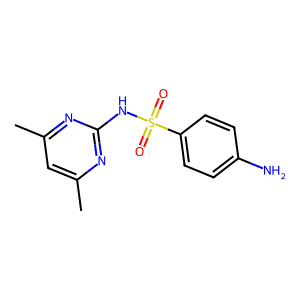 Cas:57-68-1

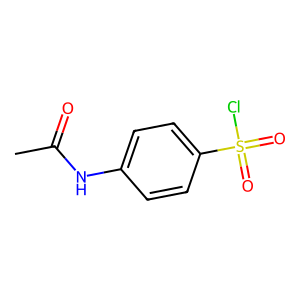 Cas:121-60-8

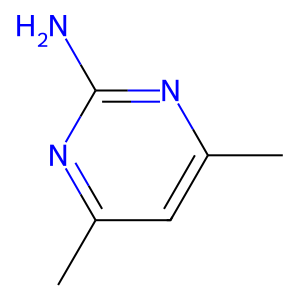 Cas:767-15-7
 Cas:121-61-9
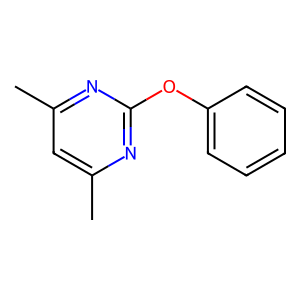 Cas:7220-71-5