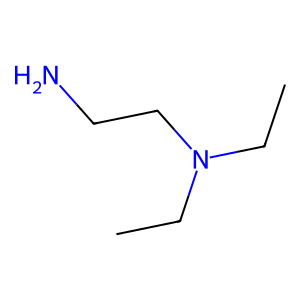
N,N-Diethylethylenediamine
CAS No.:
100-36-7
M. Wt:
116.205
M. Fa:
C6H16N2
InChI Key:
UDGSVBYJWHOHNN-UHFFFAOYSA-N
Appearance:
Colorless to Light yellow clear liquid
Names and Identifiers of N,N-Diethylethylenediamine
CAS Number |
100-36-7 |
|---|---|
EC Number |
202-844-7 |
MDL Number |
MFCD00008176 |
IUPAC Name |
N',N'-diethylethane-1,2-diamine |
InChI |
InChI=1S/C6H16N2/c1-3-8(4-2)6-5-7/h3-7H2,1-2H3 |
InChIKey |
UDGSVBYJWHOHNN-UHFFFAOYSA-N |
Canonical SMILES |
CCN(CC)CCN |
UNII |
859V6OK12Y |
UNSPSC Code |
12352100 |
UN Number |
2685 |
Physical and chemical properties of N,N-Diethylethylenediamine
Acidity coefficient |
pK1:7.70(+2);pK2:10.46(+1) (25°C) |
|---|---|
Boiling Point |
142.5±8.0 °C at 760 mmHg |
BRN |
605299 |
Density |
0.8±0.1 g/cm3 |
Exact Mass |
116.131348 |
explosive limit |
0.7-8.4%(V) |
Flash Point |
30.6±0.0 °C |
Index of Refraction |
1.448 |
LogP |
0.21 |
Melting Point |
<-70ºC |
Molecular Formula |
C6H16N2 |
Molecular Weight |
116.205 |
PSA |
29.26000 |
Sensitivity |
Air Sensitive |
Storage condition |
Store below +30°C. |
Vapour Pressure |
2.97 [mmHg] |
Water Solubility |
MISCIBLE |
Safety Information of N,N-Diethylethylenediamine


Applications of N,N-Diethylethylenediamine
N,N-Diethylethylenediamine has diverse applications across various fields:
- Pharmaceuticals: It is instrumental in synthesizing anti-malarial compounds and other pharmaceuticals.
- Chemical Synthesis: Used as a reagent in organic synthesis for producing various chemical intermediates.
- Imaging Agents: Involved in developing imaging agents for melanoma targeting using positron emission tomography and single-photon emission computed tomography.
Interaction Studies of N,N-Diethylethylenediamine
Interaction studies of N,N-Diethylethylenediamine reveal its reactivity with several chemical classes:
- Incompatibility with Isocyanates and Halogenated Organics: It may react violently with these compounds, necessitating caution during handling.
- Reducing Agent Properties: As a strong reducing agent, it can generate flammable gases when combined with certain strong oxidizers.
Biological Activity of N,N-Diethylethylenediamine
Research indicates that N,N-Diethylethylenediamine exhibits biological activities, including:
- Induction of Apoptosis: It has been shown to induce apoptosis through a caspase-3 dependent pathway, suggesting potential applications in cancer therapy.
- Anti-Malarial Synthesis: The compound is utilized in the synthesis of anti-malarial drugs, highlighting its significance in medicinal chemistry.
Physical sample testing spectrum (NMR) of N,N-Diethylethylenediamine

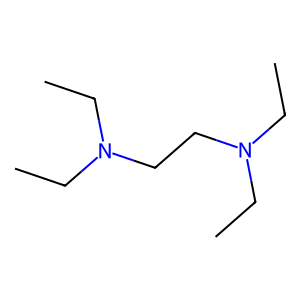 Cas:150-77-6

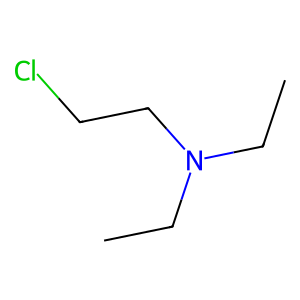 Cas:100-35-6

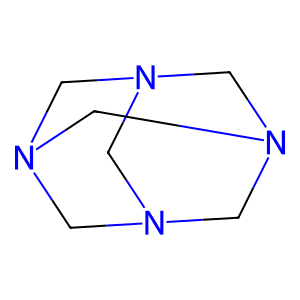 Cas:100-97-0