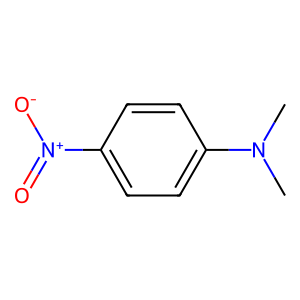
N,N-Dimethyl-4-nitroaniline
Names and Identifiers of N,N-Dimethyl-4-nitroaniline
CAS Number |
100-23-2 |
|---|---|
EC Number |
202-832-1 |
MDL Number |
MFCD00014712 |
IUPAC Name |
N,N-dimethyl-4-nitroaniline |
InChI |
InChI=1S/C8H10N2O2/c1-9(2)7-3-5-8(6-4-7)10(11)12/h3-6H,1-2H3 |
InChIKey |
QJAIOCKFIORVFU-UHFFFAOYSA-N |
Canonical SMILES |
CN(C)C1=CC=C(C=C1)[N+](=O)[O-] |
UNII |
H347TX7J9K |
UNSPSC Code |
12352100 |
Physical and chemical properties of N,N-Dimethyl-4-nitroaniline
Boiling Point |
287.6±23.0 °C at 760 mmHg |
|---|---|
Density |
1.2±0.1 g/cm3 |
Exact Mass |
166.074234 |
Flash Point |
127.7±22.6 °C |
Index of Refraction |
1.592 |
LogP |
2.61 |
Melting Point |
163-165 °C |
Molecular Formula |
C8H10N2O2 |
Molecular Weight |
166.177 |
PSA |
49.06000 |
Vapour Pressure |
0.0±0.6 mmHg at 25°C |
Safety Information of N,N-Dimethyl-4-nitroaniline

Applications of N,N-Dimethyl-4-nitroaniline
N,N-Dimethyl-4-nitroaniline finds applications in several fields:
- Dyes and Pigments: It serves as an intermediate in the synthesis of azo dyes and other colorants.
- Pharmaceuticals: Its derivatives are explored for potential use in medicinal chemistry due to their biological activities.
- Analytical Chemistry: It is used in diagnostic assays and histological staining processes.
Interaction Studies of N,N-Dimethyl-4-nitroaniline
Studies have demonstrated that N,N-Dimethyl-4-nitroaniline interacts with various biological molecules, leading to alterations in cellular functions. For instance, its ability to generate reactive oxygen species has been linked to oxidative stress in cells. Furthermore, its interactions with proteins can influence enzymatic activities, which may contribute to its mutagenic properties.
Biological Activity of N,N-Dimethyl-4-nitroaniline
Research indicates that N,N-Dimethyl-4-nitroaniline exhibits biological activity, particularly as a potential mutagen and carcinogen. Its derivatives have been studied for their effects on cellular systems, including oxidative stress responses. The compound's structure allows it to interact with various biological targets, which may lead to significant toxicological effects.
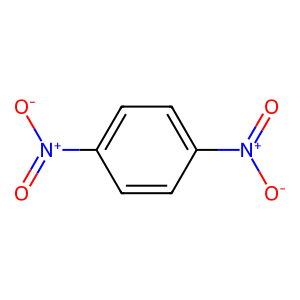 Cas:100-25-4

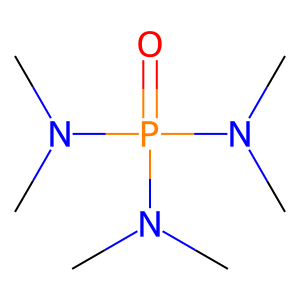 Cas:680-31-9

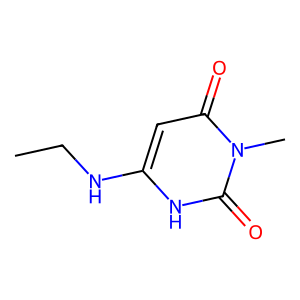 Cas:58669-01-5