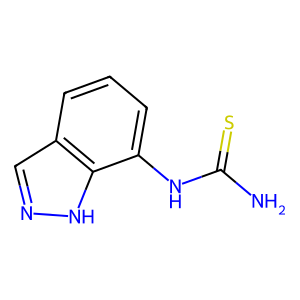
N-(1H-INDAZOL-7-YL)THIOUREA
Names and Identifiers of N-(1H-INDAZOL-7-YL)THIOUREA
CAS Number |
381211-75-2 |
|---|---|
MDL Number |
MFCD03102719 |
IUPAC Name |
(1H-indazol-7-yl)thiourea |
InChI |
InChI=1S/C8H8N4S/c9-8(13)11-6-3-1-2-5-4-10-12-7(5)6/h1-4H,(H,10,12)(H3,9,11,13) |
InChIKey |
UVXLTGRPKGRTCE-UHFFFAOYSA-N |
Canonical SMILES |
NC(=S)NC1=CC=CC2=C1NN=C2 |
UNSPSC Code |
12352100 |
Physical and chemical properties of N-(1H-INDAZOL-7-YL)THIOUREA
Boiling Point |
430.5±37.0 °C at 760 mmHg |
|---|---|
Density |
1.6±0.1 g/cm3 |
Exact Mass |
192.046967 |
Flash Point |
214.2±26.5 °C |
H Bond Acceptors |
1 |
H Bond Donors |
3 |
Index of Refraction |
1.894 |
LogP |
0.33 |
Melting Point |
203-204 |
Molecular Formula |
C8H8N4S |
Molecular Weight |
192.241 |
Vapour Pressure |
0.0±1.0 mmHg at 25°C |
Safety Information of N-(1H-INDAZOL-7-YL)THIOUREA

Applications of N-(1H-INDAZOL-7-YL)THIOUREA
N-(1H-indazol-7-yl)thiourea has several applications in medicinal chemistry:
- Anticancer Research: Its role as an RTK inhibitor positions it as a candidate for developing new cancer therapies.
- Biochemical Research: It is utilized in proteomics research due to its ability to interact with specific proteins involved in cellular signaling pathways.
- Drug Development: The compound serves as a scaffold for designing new drugs targeting various diseases linked to dysregulated kinase activity.
Interaction Studies of N-(1H-INDAZOL-7-YL)THIOUREA
Interaction studies involving N-(1H-indazol-7-yl)thiourea focus on its binding affinity to target proteins, particularly receptor tyrosine kinases. Molecular docking simulations have been employed to predict how this compound interacts with specific binding sites on these proteins, providing insights into its mechanism of action and potential efficacy as an inhibitor.
In vitro studies have shown that derivatives of thiourea exhibit varying degrees of cytotoxicity against different cancer cell lines, suggesting that modifications to the structure can enhance or diminish biological activity
Research indicates that N-(1H-indazol-7-yl)thiourea exhibits significant biological activities, particularly as an inhibitor of receptor tyrosine kinases (RTKs). These enzymes are crucial in regulating cell division and survival, making them important targets in cancer therapy. The compound has shown promising results in inhibiting angiogenesis, which is the formation of new blood vessels that tumors require for growth and metastasis
Biological Activity of N-(1H-INDAZOL-7-YL)THIOUREA