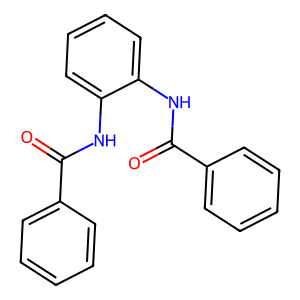
N-(2-benzamidophenyl)benzamide
Names and Identifiers of N-(2-benzamidophenyl)benzamide
CAS Number |
744-38-7 |
|---|---|
EC Number |
662-741-1 |
IUPAC Name |
N-(2-benzamidophenyl)benzamide |
InChI |
InChI=1S/C20H16N2O2/c23-19(15-9-3-1-4-10-15)21-17-13-7-8-14-18(17)22-20(24)16-11-5-2-6-12-16/h1-14H,(H,21,23)(H,22,24) |
InChIKey |
PDRZOLRKTPJCNY-UHFFFAOYSA-N |
Canonical SMILES |
C1=CC=C(C=C1)C(=O)NC2=CC=CC=C2NC(=O)C3=CC=CC=C3 |
Physical and chemical properties of N-(2-benzamidophenyl)benzamide
Boiling Point |
358.2ºC at 760 mmHg |
|---|---|
Density |
1.279g/cm3 |
Exact Mass |
316.12100 |
Flash Point |
103.8ºC |
Index of Refraction |
1.698 |
LogP |
4.33720 |
Molecular Formula |
C20H16N2O2 |
Molecular Weight |
316.35300 |
PSA |
58.20000 |
Safety Information of N-(2-benzamidophenyl)benzamide

Applications of N-(2-benzamidophenyl)benzamide
N-(2-benzamidophenyl)benzamide has potential applications in various fields:
- Pharmaceuticals: As a lead compound in drug development, particularly for anticancer therapies targeting PARP enzymes.
- Chemical Research: Used as a building block in organic synthesis to create more complex molecules.
- Material Science: Potential applications in developing new materials due to its unique structural properties.
Interaction Studies of N-(2-benzamidophenyl)benzamide
Interaction studies involving N-(2-benzamidophenyl)benzamide have focused on its binding affinity to target proteins involved in cancer cell proliferation and survival. These studies utilize techniques such as molecular docking and surface plasmon resonance to elucidate binding mechanisms and affinities. Such interactions are critical for understanding the compound's efficacy as a therapeutic agent.
Biological Activity of N-(2-benzamidophenyl)benzamide
N-(2-benzamidophenyl)benzamide has been investigated for its potential biological activities, particularly in the context of cancer therapy. Studies suggest that derivatives of benzamide compounds can act as inhibitors for key enzymes involved in cancer progression, such as poly(ADP-ribose) polymerase-1 (PARP-1). This inhibition is crucial in cancer treatment strategies aimed at exploiting DNA repair mechanisms.
Moreover, research has indicated that similar compounds exhibit antitumor activity by targeting specific cellular pathways, making N-(2-benzamidophenyl)benzamide a candidate for further pharmacological studies.
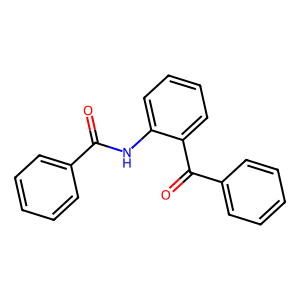 Cas:29670-64-2

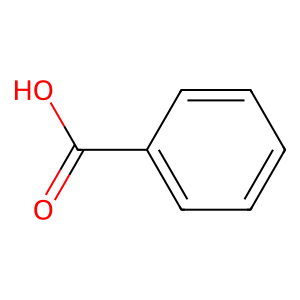 Cas:65-85-0

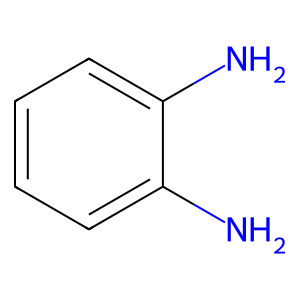 Cas:95-54-5
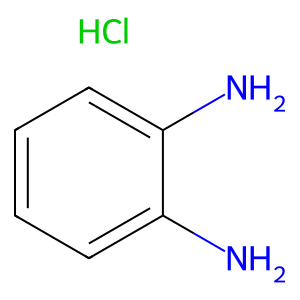 Cas:39145-59-0
 Cas:7732-18-5
 Cas:98-88-4