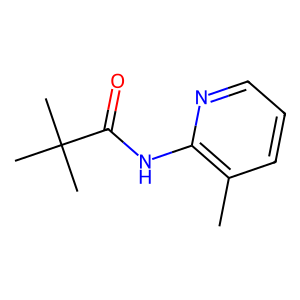
N-(3-methylpyridin-2-yl)pivalamide
Names and Identifiers of N-(3-methylpyridin-2-yl)pivalamide
CAS Number |
86847-66-7 |
|---|---|
IUPAC Name |
2,2-dimethyl-N-(3-methylpyridin-2-yl)propanamide |
InChI |
InChI=1S/C11H16N2O/c1-8-6-5-7-12-9(8)13-10(14)11(2,3)4/h5-7H,1-4H3,(H,12,13,14) |
InChIKey |
ZBCUAOCZXRLXRZ-UHFFFAOYSA-N |
Canonical SMILES |
CC1=C(N=CC=C1)NC(=O)C(C)(C)C |
Physical and chemical properties of N-(3-methylpyridin-2-yl)pivalamide
Exact Mass |
192.12600 |
|---|---|
LogP |
2.44760 |
Melting Point |
85-88℃ (hexane ) |
Molecular Formula |
C11H16N2O |
Molecular Weight |
192.25800 |
PSA |
41.99000 |
Applications of N-(3-methylpyridin-2-yl)pivalamide
N-(3-methylpyridin-2-yl)pivalamide has several applications:
- Medicinal Chemistry: It is investigated for its potential use as a drug candidate due to its biological activity.
- Synthetic Organic Chemistry: The compound serves as an intermediate in the synthesis of other complex molecules.
- Research Tool: It can be used in studies exploring enzyme interactions and receptor binding mechanisms.
Interaction Studies of N-(3-methylpyridin-2-yl)pivalamide
Interaction studies involving N-(3-methylpyridin-2-yl)pivalamide have revealed insights into its binding mechanisms with various biological targets. Notably, the compound's ability to form hydrogen bonds with active sites on enzymes or receptors may inhibit their activity. Additionally, the structural features contribute to its efficacy as an inhibitor in biochemical pathways, influencing its pharmacological properties.
Biological Activity of N-(3-methylpyridin-2-yl)pivalamide
N-(3-methylpyridin-2-yl)pivalamide exhibits significant biological activity, particularly in medicinal chemistry. Its structure allows it to interact with various biological targets, including enzymes and receptors. Research indicates that compounds with similar structures may exhibit antitumor activity and serve as inhibitors in various biochemical pathways. The unique positioning of the methyl group and pivalamide moiety contributes to its binding affinity and selectivity towards specific molecular targets.
 Cas:74-88-4

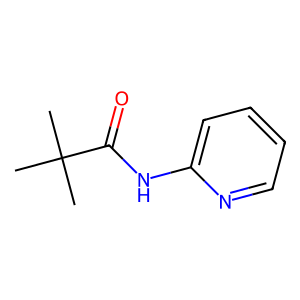 Cas:86847-59-8

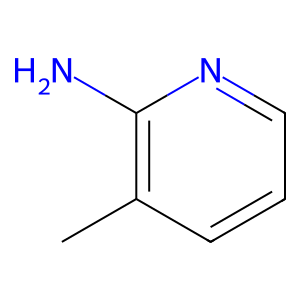 Cas:1603-40-3
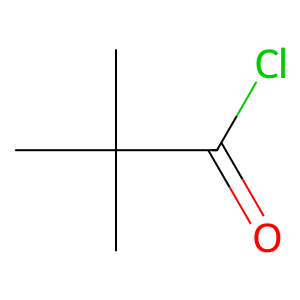 Cas:3282-30-2