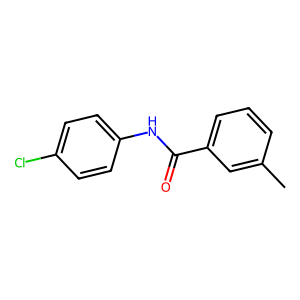
N-(4-chlorophenyl)-3-methylbenzamide
Names and Identifiers of N-(4-chlorophenyl)-3-methylbenzamide
CAS Number |
81636-14-8 |
|---|---|
EC Number |
666-936-2 |
MDL Number |
MFCD00088528 |
IUPAC Name |
N-(4-chlorophenyl)-3-methylbenzamide |
InChI |
InChI=1S/C14H12ClNO/c1-10-3-2-4-11(9-10)14(17)16-13-7-5-12(15)6-8-13/h2-9H,1H3,(H,16,17) |
InChIKey |
DDOSHRIGQWXMMY-UHFFFAOYSA-N |
Canonical SMILES |
CC1=CC(=CC=C1)C(=O)NC2=CC=C(C=C2)Cl |
UNSPSC Code |
12352100 |
Physical and chemical properties of N-(4-chlorophenyl)-3-methylbenzamide
Exact Mass |
245.06100 |
|---|---|
H Bond Acceptors |
1 |
H Bond Donors |
1 |
LogP |
3.97370 |
Molecular Formula |
C14H12ClNO |
Molecular Weight |
245.70400 |
PSA |
29.10000 |
Safety Information of N-(4-chlorophenyl)-3-methylbenzamide

Applications of N-(4-chlorophenyl)-3-methylbenzamide
N-(4-chlorophenyl)-3-methylbenzamide has potential applications in pharmaceuticals, particularly as a precursor for synthesizing various biologically active compounds. Its unique structure makes it suitable for designing new drugs targeting specific biological pathways, especially in pain management and inflammation control. Additionally, it may serve as an intermediate in organic synthesis for creating more complex molecules.
Interaction Studies of N-(4-chlorophenyl)-3-methylbenzamide
Studies have indicated that N-(4-chlorophenyl)-3-methylbenzamide interacts with several biological targets, including enzymes involved in metabolic pathways. Its inhibitory effects on specific enzymes have been documented, suggesting potential therapeutic uses in treating diseases linked to these targets. Further computational studies have provided insights into its binding affinities and mechanisms of action at the molecular level.
Biological Activity of N-(4-chlorophenyl)-3-methylbenzamide
This compound exhibits notable biological activities, particularly in pharmacology. It has been studied for its potential as an enzyme inhibitor and its interactions with various biological targets. The chlorophenyl group contributes to its lipophilicity, enhancing its ability to penetrate biological membranes and interact with cellular targets. Research indicates that it may exhibit anti-inflammatory and analgesic properties, making it a candidate for further pharmacological exploration.
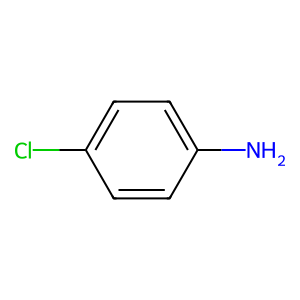 Cas:106-47-8

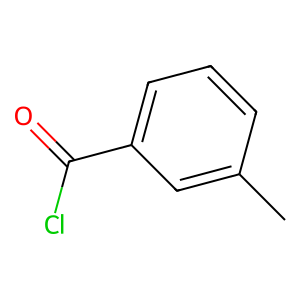 Cas:1711-06-4

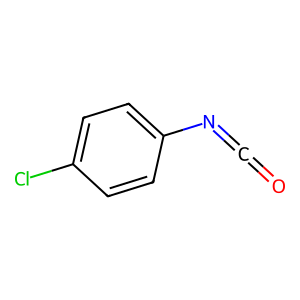 Cas:104-12-1
 Cas:499-06-9