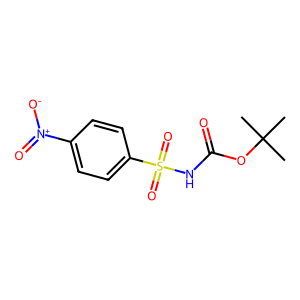
N-Boc-4-nitrobenzenesulfonamide
Names and Identifiers of N-Boc-4-nitrobenzenesulfonamide
CAS Number |
895153-23-8 |
|---|---|
MDL Number |
MFCD25968514 |
IUPAC Name |
tert-butyl N-(4-nitrophenyl)sulfonylcarbamate |
InChI |
InChI=1S/C11H14N2O6S/c1-11(2,3)19-10(14)12-20(17,18)9-6-4-8(5-7-9)13(15)16/h4-7H,1-3H3,(H,12,14) |
InChIKey |
KURDKBAAQRGXSB-UHFFFAOYSA-N |
Canonical SMILES |
CC(C)(C)OC(=O)NS(=O)(=O)C1=CC=C(C=C1)[N+](=O)[O-] |
UNSPSC Code |
12352100 |
Physical and chemical properties of N-Boc-4-nitrobenzenesulfonamide
Acidity coefficient |
3.71±0.10(Predicted) |
|---|---|
Density |
1.365±0.06 g/cm3(Predicted) |
Exact Mass |
302.057251 |
Index of Refraction |
1.547 |
LogP |
2.30 |
Melting Point |
122-123 °C(Solv: ethanol (64-17-5)) |
Molecular Formula |
C11H14N2O6S |
Molecular Weight |
302.30366 |
Storage condition |
Sealed in dry,Room Temperature |
Safety Information of N-Boc-4-nitrobenzenesulfonamide

Applications of N-Boc-4-nitrobenzenesulfonamide
N-Boc-4-nitrobenzenesulfonamide finds applications in various fields:
- Pharmaceuticals: It serves as an intermediate in the synthesis of pharmaceutical compounds, particularly those targeting bacterial infections.
- Organic Synthesis: This compound is widely used in organic chemistry for the preparation of amines and other nitrogen-containing compounds.
- Material Science: It may also have applications in developing novel materials due to its unique chemical properties.
Interaction Studies of N-Boc-4-nitrobenzenesulfonamide
Studies on N-Boc-4-nitrobenzenesulfonamide's interactions reveal its potential as a lead compound for drug development. Its interactions with biological targets have been explored to assess its efficacy and safety profile. For instance, research indicates that modifications to the sulfonamide group can enhance antibacterial activity while reducing toxicity.
Biological Activity of N-Boc-4-nitrobenzenesulfonamide
N-Boc-4-nitrobenzenesulfonamide exhibits notable biological activities, primarily attributed to its sulfonamide component. Sulfonamides are known for their antibacterial properties, acting as competitive inhibitors of bacterial dihydropteroate synthase, an enzyme crucial for folate synthesis. This mechanism makes them effective against various bacterial infections. Additionally, compounds in this class have shown potential anti-inflammatory and antitumor activities.
Physical sample testing spectrum (NMR) of N-Boc-4-nitrobenzenesulfonamide

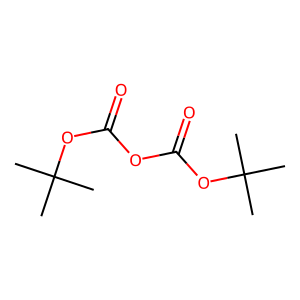 Cas:24424-99-5

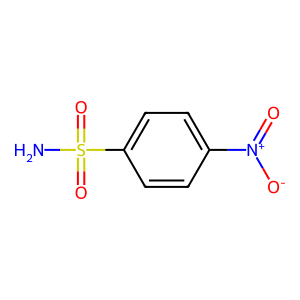 Cas:6325-93-5
