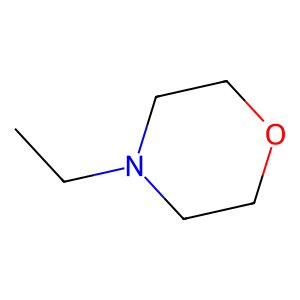
N-Ethylmorpholine
CAS No.:
100-74-3
M. Wt:
115.17400
M. Fa:
C6H13NO
InChI Key:
HVCNXQOWACZAFN-UHFFFAOYSA-N
Appearance:
Colorless to Yellow Liquid
Names and Identifiers of N-Ethylmorpholine
CAS Number |
100-74-3 |
|---|---|
EC Number |
202-885-0 |
MDL Number |
MFCD00006177 |
IUPAC Name |
4-ethylmorpholine |
InChI |
InChI=1S/C6H13NO/c1-2-7-3-5-8-6-4-7/h2-6H2,1H3 |
InChIKey |
HVCNXQOWACZAFN-UHFFFAOYSA-N |
Canonical SMILES |
CCN1CCOCC1 |
UNII |
ECM0G991FQ |
UNSPSC Code |
12352100 |
Physical and chemical properties of N-Ethylmorpholine
Acidity coefficient |
7.67(at 25℃) |
|---|---|
Boiling Point |
281 °F |
BRN |
102969 |
Density |
0.90 |
Exact Mass |
115.10000 |
explosive limit |
1.9%(V) |
Flash Point |
(oc) 90 °F |
Freezing Point |
-63℃ |
Index of Refraction |
INDEX OF REFRACTION: 1.4400 @ 20 °C/D; SADTLER REFERENCE NUMBER: 11309 (IR, PRISM) |
LogP |
0.27640 |
Melting Point |
-81 °F |
Molecular Formula |
C6H13NO |
Molecular Weight |
115.17400 |
Odor |
Ammonia-like odor. |
pH |
11.8 (100g/l, H2O, 20℃) |
PSA |
12.47000 |
Sensitivity |
Air Sensitive |
Solubility |
Miscible |
Stability |
Stable. Flammable. Incompatible with strong oxidizing agents. Slightly air sensitive. |
Storage condition |
Store below +30°C. |
Vapour density |
Relative vapor density (air = 1): 4.0 |
Vapour Pressure |
6 mmHg |
Water Solubility |
miscible |
Safety Information of N-Ethylmorpholine


Applications of N-Ethylmorpholine
4-Ethylmorpholine finds applications in various fields:
- Chemical Synthesis: It serves as a reagent in organic synthesis, particularly for coupling reactions involving carboxylic acids and lactones.
- Pharmaceuticals: Its potential biological activity makes it a candidate for drug development.
- Industrial Uses: It is used in the formulation of coatings, adhesives, and rubber products due to its solvent properties.
Interaction Studies of N-Ethylmorpholine
Interaction studies involving 4-Ethylmorpholine focus on its reactivity with other chemicals and potential biological interactions:
- Reactivity with Oxidizers: The compound reacts vigorously with strong oxidizing agents, posing fire and explosion hazards.
- Biological Interactions: Studies on its toxicity indicate that it can affect human health through dermal absorption and inhalation exposure, necessitating safety precautions during handling.
Biological Activity of N-Ethylmorpholine
Research indicates that 4-Ethylmorpholine exhibits biological activity, particularly in relation to its effects on human health. Some findings include:
- Toxicity: It is classified as a hazardous substance that can cause skin burns and eye damage upon contact. Prolonged exposure may lead to organ damage.
- Antimicrobial Properties: Preliminary studies suggest potential antimicrobial activity, making it a candidate for further investigation in pharmaceutical applications.
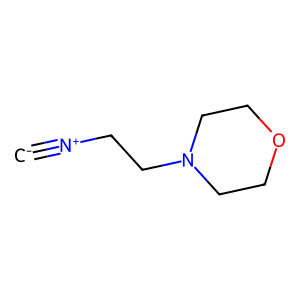 Cas:78375-48-1

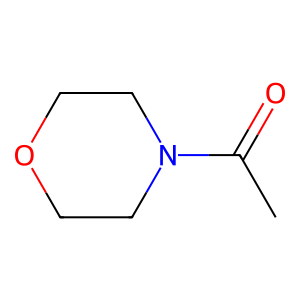 Cas:1696-20-4
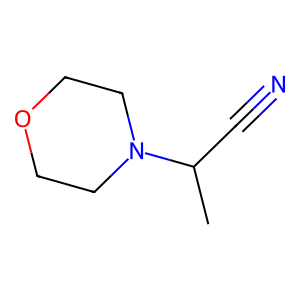 Cas:3626-56-0