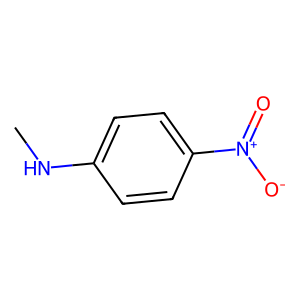
N-Methyl-4-nitroaniline
Names and Identifiers of N-Methyl-4-nitroaniline
CAS Number |
100-15-2 |
|---|---|
EC Number |
202-823-2 |
IUPAC Name |
N-methyl-4-nitroaniline |
InChI |
InChI=1S/C7H8N2O2/c1-8-6-2-4-7(5-3-6)9(10)11/h2-5,8H,1H3 |
InChIKey |
XIFJZJPMHNUGRA-UHFFFAOYSA-N |
Canonical SMILES |
CNC1=CC=C(C=C1)[N+](=O)[O-] |
UNII |
J836WLV9BW |
Physical and chemical properties of N-Methyl-4-nitroaniline
Acidity coefficient |
0.56±0.12(Predicted) |
|---|---|
Boiling Point |
Decomposes (NTP, 1992) |
BRN |
637920 |
Density |
1.201 at 311 °F (NTP, 1992) |
Exact Mass |
152.058578 |
Flash Point |
129.5±22.6 °C |
Index of Refraction |
1.620 |
LogP |
2.04 |
Melting Point |
306 °F (NTP, 1992) |
Molecular Formula |
C7H8N2O2 |
Molecular Weight |
152.151 |
PSA |
57.85000 |
Solubility |
less than 1 mg/mL at 66 °F (NTP, 1992) |
Stability |
Stable. Combustible. Incompatible with strong oxidizing agents. |
Storage condition |
Keep in dark place,Inert atmosphere,Room temperature |
Vapour density |
5.25 (vs air) |
Vapour Pressure |
0.00764 [mmHg] |
Water Solubility |
<0.1 g/100 mL at 19 ºC |
Safety Information of N-Methyl-4-nitroaniline


Applications of N-Methyl-4-nitroaniline
Interaction Studies of N-Methyl-4-nitroaniline
Interaction studies focusing on N-Methyl-4-nitroaniline have primarily examined its behavior in environmental contexts. Research indicates that while it may undergo microbial degradation under anaerobic conditions, aerobic degradation remains less documented. Soil microcosm studies have shown efficient degradation by soil microorganisms, suggesting potential pathways for bioremediation. Its interactions with other chemicals also warrant caution due to possible hazardous reactions when combined with strong oxidizers or heated above certain temperatures.
Biological Activity of N-Methyl-4-nitroaniline
The biological activity of N-Methyl-4-nitroaniline has been studied primarily in terms of its environmental impact and potential toxicity. While specific pharmacological effects are not well-documented, its classification as an aromatic amine raises concerns regarding mutagenicity and carcinogenicity. Studies indicate that compounds of this class may pose risks to human health and the environment due to their persistence and potential for bioaccumulation.
Physical sample testing spectrum (NMR) of N-Methyl-4-nitroaniline

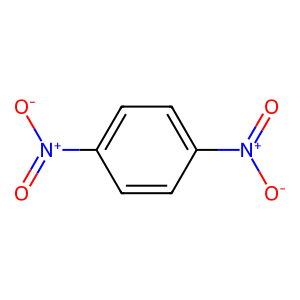 Cas:100-25-4

 Cas:74-89-5

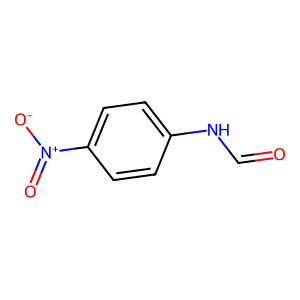 Cas:16135-31-2
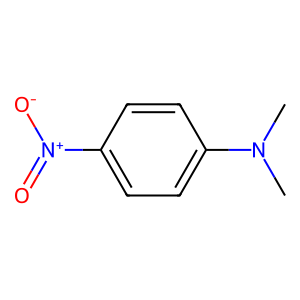 Cas:100-23-2