
N-Methylaniline
CAS No.:
100-61-8
M. Wt:
107.153
M. Fa:
C7H9N
InChI Key:
AFBPFSWMIHJQDM-UHFFFAOYSA-N
Appearance:
Colorless to Light orange to Yellow clear liquid
Names and Identifiers of N-Methylaniline
CAS Number |
100-61-8 |
|---|---|
EC Number |
202-870-9 |
MDL Number |
MFCD00008283 |
IUPAC Name |
N-methylaniline |
InChI |
InChI=1S/C7H9N/c1-8-7-5-3-2-4-6-7/h2-6,8H,1H3 |
InChIKey |
AFBPFSWMIHJQDM-UHFFFAOYSA-N |
Canonical SMILES |
CNC1=CC=CC=C1 |
UNII |
TH45GK410O |
UNSPSC Code |
12352100 |
UN Number |
2294 |
Physical and chemical properties of N-Methylaniline
Acidity coefficient |
4.84(at 25℃) |
|---|---|
Boiling Point |
384 °F |
BRN |
741982 |
Decomposition |
WHEN HEATED TO DECOMP, IT EMITS HIGHLY TOXIC FUMES OF /NITROGEN OXIDES/. |
Density |
0.99 |
Exact Mass |
107.073502 |
Flash Point |
175 °F |
Index of Refraction |
Index of refraction: 1.57367 @ 15 °C/D; 1.5684 @ 25 °C/D |
LogP |
1.7 |
Melting Point |
-71 °F |
Merck |
14,6019 |
Molecular Formula |
C7H9N |
Molecular Weight |
107.153 |
Odor |
Weak, ammonia-like odor. |
pH |
7.6 (1g/l, H2O, 20℃) |
PSA |
12.03000 |
Sensitivity |
Air Sensitive |
Solubility |
5.6g/L at 20°C in Water |
Stability |
Stability Combustible. Incompatible with strong oxidizing agents. Discolours upon exposure to air. |
Storage condition |
Store below +30°C. |
Vapour density |
3.9 |
Vapour Pressure |
0.3 mmHg |
Water Solubility |
30 g/L |
Solubility of N-Methylaniline
| Solvent | Dissolution Behavior | Temperature Effect | pH Effect |
|---|---|---|---|
| Water | Slightly soluble, forms oily layers | Solubility increases slightly with rising temperature | In acidic conditions (low pH), protonation occurs and solubility significantly increases; solubility is low under basic conditions |
| Ethanol | Freely soluble, completely miscible | Higher temperature enhances dissolution, but already fully miscible at room temperature | Minimal pH effect, as ethanol is a non-aqueous solvent |
| Diethyl ether | Soluble, forms a homogeneous solution | Temperature has little effect | Essentially unaffected by pH |
| Benzene | Soluble, good miscibility | Solubility improves with increasing temperature | Unaffected by pH |
| Acetone | Freely soluble, completely miscible | Higher temperature further promotes dissolution | pH effect is negligible |
| Dilute Hydrochloric Acid | Reacts to form a salt, producing a water-soluble ionic compound | Heating accelerates the salt formation process | Under strongly acidic conditions (low pH), converts to N-methylaniline hydrochloride, greatly enhancing water solubility |
Safety Information of N-Methylaniline


Key Milestone of N-Methylaniline
| Year(s) | Event / Milestone | Key Person(s) / Organization(s) | Significance / Impact |
|---|---|---|---|
| 1840s–1850s | First synthesis and structural confirmation | August Wilhelm von Hofmann and other early organic chemists | N-Methylaniline was synthesized as a simple N-substituted aromatic amine during the boom in aniline-derivative research, advancing amine chemistry. |
| 1860s–1870s | Application as a dye intermediate | German dye industry (e.g., BASF, Hoechst) | Used to synthesize early aniline dyes such as methyl violet and crystal violet (triphenylmethane dyes), spurring the rise of the synthetic dye industry. |
| 1880s–1890s | Initial forays into medicinal chemistry | Various pharmaceutical chemists | Served as a precursor for nitrogen-containing heterocyclic drugs; explored for analgesic and antipyretic analogues of phenacetin. |
| 1900s–1930s | Use as rubber additive and antioxidant | Rubber industry (e.g., Goodyear, Continental AG) | NMA and its derivatives retarded rubber aging, enhancing the durability of tires and other rubber products. |
| 1940s–1950s | Expanded role in pesticide synthesis | Pesticide R&D institutes (e.g., ICI, Bayer) | Acted as an intermediate for certain insecticides and herbicides, including early carbamate compounds. |
| 1960s–1980s | Widespread adoption as an organic-synthesis reagent | Academia and the fine-chemicals sector | Employed to prepare Schiff bases, metal ligands, and pharmaceutical intermediates (e.g., precursors for antimalarials and antidepressants). |
| 1990s–2000s | Strengthened safety and environmental regulations | Regulatory agencies such as EPA and REACH | Restrictions on use were imposed due to its toxicity (hepatotoxicity, potential carcinogenicity) and environmental risks, driving the search for safer alternatives. |
| 2010s–present | Exploration in advanced materials and functional molecules | Universities and research institutes (e.g., MIT, CAS) | Utilized in cutting-edge fields to synthesize optoelectronic materials, ionic liquids, and ligands for metal–organic frameworks (MOFs). |
Applications of N-Methylaniline
Interaction Studies of N-Methylaniline
Interaction studies have shown that N-methylaniline may react with various compounds:
- Compatibility Issues: It may be incompatible with isocyanates and halogenated organics, highlighting the need for careful handling when combined with other chemicals.
- Reactivity Profiles: The compound reacts vigorously with strong acids and oxidants, producing toxic fumes that necessitate stringent safety protocols during use.
Several compounds share structural similarities with N-methylaniline. Here’s a comparison highlighting its uniqueness:
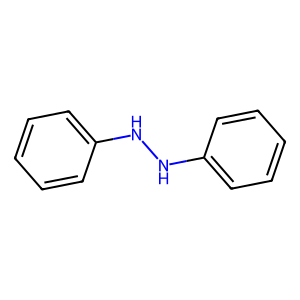 Cas:122-66-7

 Cas:25015-63-8

 Cas:932-96-7
 Cas:1978-37-6