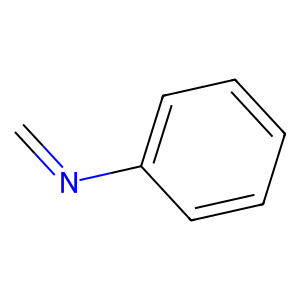
N-Methyleneaniline
CAS No.:
100-62-9
M. Wt:
105.13700
M. Fa:
C7H7N
InChI Key:
VULHYRAYXYTONQ-UHFFFAOYSA-N
Names and Identifiers of N-Methyleneaniline
CAS Number |
100-62-9 |
|---|---|
EC Number |
202-871-4 |
IUPAC Name |
N-phenylmethanimine |
InChI |
InChI=1S/C7H7N/c1-8-7-5-3-2-4-6-7/h2-6H,1H2 |
InChIKey |
VULHYRAYXYTONQ-UHFFFAOYSA-N |
Canonical SMILES |
C=NC1=CC=CC=C1 |
Physical and chemical properties of N-Methyleneaniline
Boiling Point |
169.8ºC at 760 mmHg |
|---|---|
Density |
0.87g/cm3 |
Exact Mass |
105.05800 |
Flash Point |
47.7ºC |
Index of Refraction |
1.496 |
LogP |
2.01870 |
Molecular Formula |
C7H7N |
Molecular Weight |
105.13700 |
PSA |
12.36000 |
Vapour Pressure |
2.01mmHg at 25°C |
Applications of N-Methyleneaniline
N-Methylaniline serves various industrial applications:
- Dyes and Pigments: It is widely used as an intermediate in the production of azo dyes and other colorants.
- Pharmaceuticals: The compound is involved in synthesizing pharmaceutical agents.
- Polyurethane Production: It is used in creating blocked polyisocyanates for polyurethane applications .
Interaction Studies of N-Methyleneaniline
Interaction studies have demonstrated that N-methylaniline can interact with various reagents, leading to significant changes in its reactivity profile. For instance, its compatibility with isocyanates has been explored extensively, revealing that certain substituents on the aromatic ring can enhance or inhibit its reactivity toward these compounds . Furthermore, studies have indicated that N-methylaniline may react with halogenated organics, peroxides, and phenols, suggesting careful handling due to potential incompatibilities .
 Cas:622-14-0

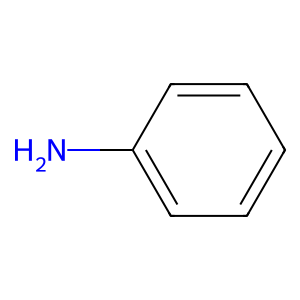 Cas:62-53-3
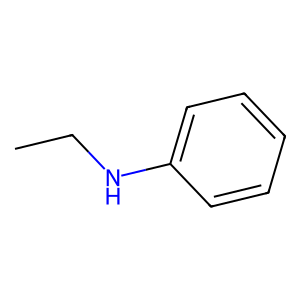 Cas:103-69-5