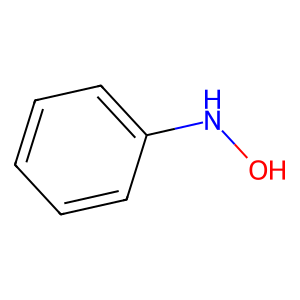
N-Phenylhydroxylamine
CAS No.:
100-65-2
M. Wt:
109.12600
M. Fa:
C6H7NO
InChI Key:
CKRZKMFTZCFYGB-UHFFFAOYSA-N
Appearance:
Faint beige fibers
Names and Identifiers of N-Phenylhydroxylamine
CAS Number |
100-65-2 |
|---|---|
EC Number |
202-875-6 |
MDL Number |
MFCD00045718 |
IUPAC Name |
N-phenylhydroxylamine |
InChI |
InChI=1S/C6H7NO/c8-7-6-4-2-1-3-5-6/h1-5,7-8H |
InChIKey |
CKRZKMFTZCFYGB-UHFFFAOYSA-N |
Canonical SMILES |
C1=CC=C(C=C1)NO |
UNII |
282MU82Z9A |
UNSPSC Code |
12352100 |
Physical and chemical properties of N-Phenylhydroxylamine
Acidity coefficient |
9.00±0.70(Predicted) |
|---|---|
Boiling Point |
215.8ºC at 760mmHg |
Density |
1.214g/cm3 |
Exact Mass |
109.05300 |
Flash Point |
120.2ºC |
Index of Refraction |
1.649 |
LogP |
1.56070 |
Melting Point |
82 °C |
Molecular Formula |
C6H7NO |
Molecular Weight |
109.12600 |
PSA |
32.26000 |
Stability |
Unstable - deteriorates with storage. Incompatible with strong oxidizing agents. |
Storage condition |
?20°C |
Vapour Pressure |
0.00795 [mmHg] |
Water Solubility |
20g/L(5 ºC) |
Solubility of N-Phenylhydroxylamine
| Solvent Name | Dissolution Behavior | Temperature Effect | pH Effect |
|---|---|---|---|
| Water | Slightly soluble | Increased solubility with rising temperature | Solubility increases under acidic conditions; may precipitate in alkaline environments |
| Alcohol (Ethanol) | Highly soluble | Solubility increases with temperature | Minimal pH effect; stable under neutral conditions |
| Methanol | Highly soluble | High solubility, heating enhances dissolution | Minimal pH effect |
| Acetone | Soluble | Fast dissolution, solubility increases with temperature | Best in neutral to weakly acidic conditions; may decompose under strong acid or strong base |
| ethyl acetate | Slightly to insoluble | Minor effect of temperature on solubility | May undergo partial hydrolysis under acidic conditions |
| Chloroform | Insoluble or very slightly soluble | Low solubility, temperature increase shows no significant improvement | Minimal pH effect, but phenylhydroxylamine is unstable in such solvents |
| DMSO | Highly soluble | Fast dissolution at room temperature | Stable in DMSO; minimal pH influence |
| DMF | Highly soluble | Fast dissolution, heating promotes solubility | Stable; pH changes have little effect on solubility |
Routine testing items of N-Phenylhydroxylamine
| Test Item | Common Testing Method | Method Overview |
|---|---|---|
| Assay | High-Performance Liquid Chromatography (HPLC) | Uses a reversed-phase column (e.g., C18) and UV detector (210–254 nm) to quantify phenylhydroxylamine content via a standard curve, offering high sensitivity and excellent separation. |
| Purity Analysis | Gas Chromatography-Mass Spectrometry (GC-MS) | After derivatization, the sample is separated by gas chromatography and impurities are identified by mass spectrometry; suitable for analyzing volatile and semi-volatile impurities. |
| Structural Confirmation | Nuclear Magnetic Resonance Spectroscopy (NMR) | Uses ¹H-NMR and ¹³C-NMR to confirm the molecular structure of phenylhydroxylamine by identifying characteristic peaks (e.g., —NH—OH, aromatic protons). |
| Functional Group Identification | Fourier Transform Infrared Spectroscopy (FT-IR) | Detects characteristic absorption bands to identify functional groups such as N–O, O–H, N–H, and aromatic rings; used for preliminary qualitative analysis. |
| Moisture Content | Karl Fischer Titration | Based on the reaction of iodine and sulfur dioxide with water in an anhydrous environment, this method accurately measures trace moisture, ideal for moisture-sensitive organic compounds. |
| Heavy Metal Residues | Atomic Absorption Spectroscopy (AAS) or Inductively Coupled Plasma Mass Spectrometry (ICP-MS) | Detects residual heavy metals such as lead, mercury, cadmium, and arsenic to ensure compliance with pharmacopeial or industrial safety standards. |
| Related Substances/Degradation Products | High-Performance Liquid Chromatography with Diode Array Detection (HPLC-DAD) | Uses a diode array detector (DAD) to simultaneously detect the main component and degradation products (e.g., nitrobenzene, aniline), assessing sample stability. |
| Melting Point Determination | Melting Point Apparatus | Determines the melting temperature range by heating the sample, used for preliminary assessment of purity and consistency. |
PPB grade of N-Phenylhydroxylamine
| Test Item | Technical Requirements |
|---|---|
| Appearance | Colorless to pale yellow transparent liquid |
| Phenylhydroxylamine Content | ≥99.0% (by HPLC or titration) |
| Moisture (H₂O) | ≤0.1% (by Karl Fischer method) |
| pH Value (1% aqueous solution) | 5.0–7.0 |
| Total Metal Ion Content | ≤10 ppb (by ICP-MS, e.g., Fe, Cu, Ni, etc.) |
| Aniline Impurity | ≤50 ppb |
| Nitrobenzene | ≤20 ppb |
| Total Organic Carbon (TOC) | ≤50 ppb |
| Particles (≥0.1 μm) | ≤100 particles/mL (particle count) |
| Bacterial Endotoxins | ≤0.01 EU/mL (for electronic-grade or pharmaceutical-grade applications) |
| Peroxides | ≤1 ppm |
| Conductivity (25°C) | ≤1.0 μS/cm |
Safety Information of N-Phenylhydroxylamine

Key Milestone of N-Phenylhydroxylamine
| Time | Event | Background/Significance |
|---|---|---|
| 1850 | First synthesis of phenylhydroxylamine | First prepared by German chemist August Wilhelm von Hofmann or his school during research on the oxidation reaction of aniline, marking the discovery of this compound. |
| 1870s | Initial elucidation of phenylhydroxylamine structure | With the development of organic chemical structure theory, chemists confirmed its structure as C₆H₅NHOH, the N-hydroxy derivative of aniline. |
| 1880 | Discovery of the Bamberger rearrangement | Eugen Bamberger discovered that phenylhydroxylamine rearranges to form p-aminophenol under acidic conditions. This reaction became a fundamental aspect of aromatic hydroxylamine chemistry and is used in synthesizing p-aminophenol (a precursor to paracetamol). |
| Early 1900s | Rise in applications as an organic synthesis intermediate | Phenylhydroxylamine was used in the synthesis of dyes, pharmaceuticals (such as paracetamol), and pesticide intermediates, advancing the fine chemical industry. |
| 1930–1940s | Confirmation of its key role in pharmaceutical synthesis | As a precursor to p-aminophenol, phenylhydroxylamine played a vital role in the industrial production route of paracetamol (acetaminophen). |
| Post-1950s | Enhanced safety and stability research | Due to the potential explosiveness and toxicity of phenylhydroxylamine, research focused on its safe storage, transportation, and the development of alternative synthetic routes (e.g., direct catalytic oxidation methods). |
| 1980s–Present | Use as a model compound in mechanistic studies | Phenylhydroxylamine has been widely used as a model compound in free radical chemistry, redox reactions, and simulations of biological metabolism, aiding in the understanding of the reaction behavior of N-hydroxy aromatic amines. |
| 21st Century | Exploration of green synthesis methods | Researchers are dedicated to developing more environmentally friendly and efficient synthetic routes for phenylhydroxylamine (e.g., electrochemical reduction of nitrobenzene) to reduce by-products and environmental impact. |
Applications of N-Phenylhydroxylamine
N-phenylhydroxylamine finds applications across various fields:
- Chemical Synthesis: It serves as an intermediate in the synthesis of pharmaceuticals and agrochemicals.
- Analytical Chemistry: The compound is used in analytical methods for detecting and quantifying nitroso compounds due to its reactivity with nitrosating agents.
- Antioxidant Research: Its potential antioxidant properties are being investigated for applications in health and nutrition.
Interaction Studies of N-Phenylhydroxylamine
Studies on N-phenylhydroxylamine have highlighted its interactions with various chemical species:
- It neutralizes acids in exothermic reactions, forming salts and water, which indicates its role in acid-base chemistry.
- The compound has been shown to interact with imidoyl chlorides to produce N-imidoyl-N-phenylhydroxylamines, suggesting versatility in organic synthesis.
Several compounds share structural or functional similarities with N-phenylhydroxylamine. Here are some notable examples:
| Compound | Structure/Formula | Unique Features |
|---|---|---|
| Hydroxylamine | NH₂OH | Simple structure; widely used as a reducing agent |
| α-Phenylhydroxylamine | C₆H₅NHOH (isomer) | Different positional isomer; distinct reactivity |
| 4-Aminophenol | C₆H₄(NH₂)OH | Product of Bamberger rearrangement; important drug |
| N-Tert-butylhydroxylamine | C₄H₉NO | Bulkier structure; used in specific organic reactions |
Physical sample testing spectrum (NMR) of N-Phenylhydroxylamine

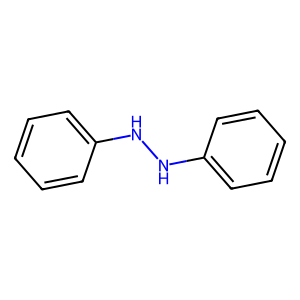 Cas:122-66-7

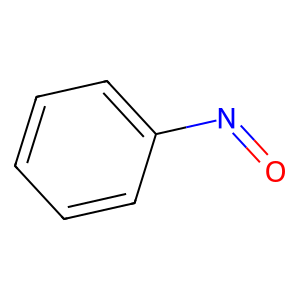 Cas:586-96-9

 Cas:31335-69-0
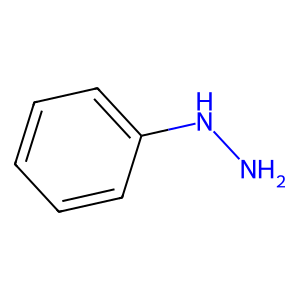 Cas:100-63-0