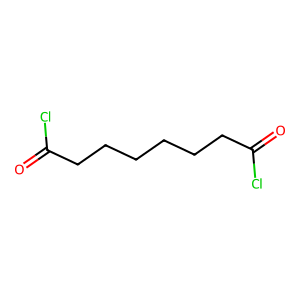
Octanedioyl dichloride
CAS No.:
10027-07-3
M. Wt:
211.08600
M. Fa:
C8H12Cl2O2
InChI Key:
PUIBKAHUQOOLSW-UHFFFAOYSA-N
Appearance:
Pale-yellow Liquid
Names and Identifiers of Octanedioyl dichloride
CAS Number |
10027-07-3 |
|---|---|
EC Number |
628-169-1 |
MDL Number |
MFCD00000764 |
IUPAC Name |
octanedioyl dichloride |
InChI |
InChI=1S/C8H12Cl2O2/c9-7(11)5-3-1-2-4-6-8(10)12/h1-6H2 |
InChIKey |
PUIBKAHUQOOLSW-UHFFFAOYSA-N |
Canonical SMILES |
C(CCCC(=O)Cl)CCC(=O)Cl |
UNII |
TG5X3247UL |
UNSPSC Code |
12352100 |
Physical and chemical properties of Octanedioyl dichloride
Boiling Point |
162-163 °C15 mm Hg(lit.) |
|---|---|
Density |
1.172 g/mL at 25 °C(lit.) |
Exact Mass |
210.02100 |
Flash Point |
>230 °F |
Index of Refraction |
n20/D 1.468(lit.) |
LogP |
2.85780 |
Melting Point |
61-62 °C |
Molecular Formula |
C8H12Cl2O2 |
Molecular Weight |
211.08600 |
PSA |
34.14000 |
Sensitivity |
Moisture Sensitive |
Storage condition |
2-8°C |
Vapour Pressure |
0.00181mmHg at 25°C |
Water Solubility |
Reacts with water. |
Safety Information of Octanedioyl dichloride

Applications of Octanedioyl dichloride
Suberoyl chloride finds applications in various fields:
- Chemical Synthesis: Used as a reagent for synthesizing hydroxyferrocifen hybrid compounds.
- Cross-Linking Agent: Enhances the mechanical properties and stability of chitosan membranes.
- Biochemical Research: Utilized in studies involving cell signaling pathways and gene expression modifications.
Its unique reactivity makes it valuable in both academic research and industrial applications.
Biological Activity of Octanedioyl dichloride
Suberoyl chloride has been noted for its biological significance, particularly in the synthesis of hydroxyferrocifen hybrid compounds. These compounds exhibit antiproliferative activity against triple-negative breast cancer cells, suggesting a potential role in cancer therapy. The compound's ability to cross-link chitosan membranes enhances their structural integrity, which can influence cellular interactions and stability, thereby affecting cellular processes such as proliferation and apoptosis.
Physical sample testing spectrum (NMR) of Octanedioyl dichloride

 Cas:505-48-6

 Cas:79-37-8

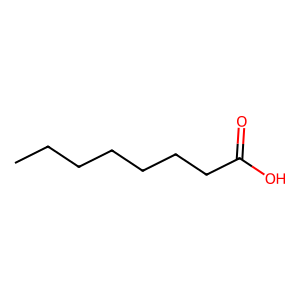 Cas:124-07-2