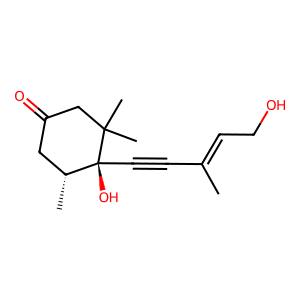
PBI 51
CAS No.:
130694-74-5
M. Wt:
250.33300
M. Fa:
C15H22O3
InChI Key:
-
Names and Identifiers of PBI 51
CAS Number |
130694-74-5 |
|---|---|
IUPAC Name |
(4S,5R)-3,3,5-trimethyl-4-[(Z)-3-methyl-5-oxidanyl-pent-3-en-1-ynyl]-4-oxidanyl-cyclohexan-1-one |
Canonical SMILES |
C[C@@H]1CC(=O)CC([C@@]1(C#C/C(=CCO)/C)O)(C)C |
Physical and chemical properties of PBI 51
Acidity coefficient |
12.29±0.60(Predicted) |
|---|---|
Boiling Point |
414.6±45.0 °C(Predicted) |
Density |
1.10±0.1 g/cm3(Predicted) |
Exact Mass |
250.15700 |
LogP |
1.68470 |
Melting Point |
97-98 °C |
Molecular Formula |
C15H22O3 |
Molecular Weight |
250.33300 |
PSA |
57.53000 |
Applications of PBI 51
The potential applications of (4S,5R)-4-hydroxy-4-((Z)-5-hydroxy-3-methylpent-3-en-1-ynyl)-3,3,5-trimethylcyclohexanone include:
- Pharmaceutical Development: As a lead compound for developing new drugs targeting specific diseases.
- Agricultural Chemicals: Investigating its efficacy as a pesticide or herbicide due to possible antimicrobial properties.
- Biochemical Probes: Utilizing its unique structure to study biological pathways and enzyme interactions.
Interaction Studies of PBI 51
Interaction studies involving this compound would typically focus on:
- Binding Affinity Studies: Assessing how well the compound binds to target proteins or receptors using techniques like surface plasmon resonance or isothermal titration calorimetry.
- Structure–Activity Relationship Analysis: Evaluating how modifications to the structure influence biological activity using quantitative structure–activity relationship (QSAR) models.
Such studies are crucial for understanding the mechanisms of action and optimizing the compound for therapeutic use.
Biological Activity of PBI 51
The biological activity of (4S,5R)-4-hydroxy-4-((Z)-5-hydroxy-3-methylpent-3-en-1-ynyl)-3,3,5-trimethylcyclohexanone is likely influenced by its structure. Compounds with similar functional groups often exhibit activities such as:
- Antioxidant properties: Hydroxy groups are known to scavenge free radicals.
- Antimicrobial effects: The structural motifs may interact with microbial enzymes or membranes.
- Potential therapeutic effects: Similar compounds have been explored for their roles in modulating biological pathways related to inflammation and cancer.
 Cas:6153-06-6

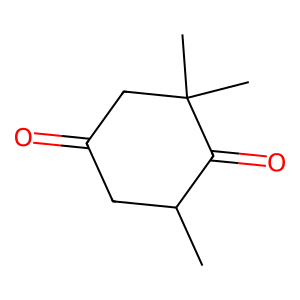 Cas:20547-99-3