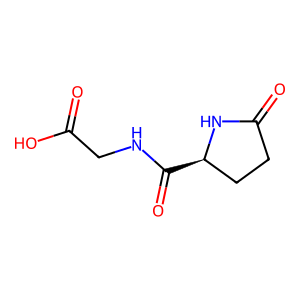
PYR-GLY-OH
Names and Identifiers of PYR-GLY-OH
CAS Number |
29227-88-1 |
|---|---|
IUPAC Name |
2-[[(2S)-5-oxidanylidenepyrrolidin-2-yl]carbonylamino]ethanoic acid |
Canonical SMILES |
C1CC(=O)N[C@@H]1C(=O)NCC(=O)O |
Physical and chemical properties of PYR-GLY-OH
Boiling Point |
659.2ºC at 760mmHg |
|---|---|
Density |
1.405g/cm3 |
Exact Mass |
186.06400 |
Flash Point |
352.5ºC |
Index of Refraction |
1.53 |
Melting Point |
170 - 172°C |
Molecular Formula |
C7H10N2O4 |
Molecular Weight |
186.17 |
PSA |
95.50000 |
Solubility |
Acetic Acid (Very Slightly), Chloroform (Slightly) |
Storage condition |
-15°C |
Vapour Pressure |
4.44E-19mmHg at 25°C |
Applications of PYR-GLY-OH
Pyroglutamylglycine has several applications:
- Food Industry: It is used as a flavor enhancer due to its ability to improve umami taste in various food products.
- Nutraceuticals: Investigated for potential health benefits related to metabolism and disease prevention.
- Research: Used in studies exploring metabolic pathways and their implications in diseases like pancreatic cancer.
Interaction Studies of PYR-GLY-OH
Interaction studies involving pyroglutamylglycine have focused on its role in metabolic processes and its interactions with other metabolites. For example, it has been shown to interact with amino acids involved in the γ-glutamyl cycle, which is crucial for amino acid metabolism and detoxification processes in the body. Additionally, its effects on taste receptors suggest potential interactions within sensory pathways that influence dietary choices.
Biological Activity of PYR-GLY-OH
Research indicates that pyroglutamylglycine exhibits biological activities that may be relevant to human health. It has been associated with the modulation of taste perception, specifically enhancing umami flavors in food. Furthermore, studies have suggested that it may play a role in metabolic pathways linked to diseases such as pancreatic cancer, where specific metabolites, including pyroglutamylglycine, have shown significant associations with disease risk.
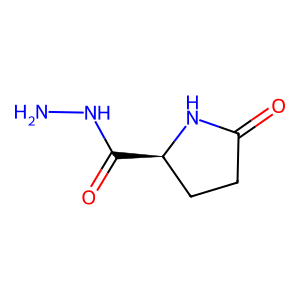 Cas:934-06-5

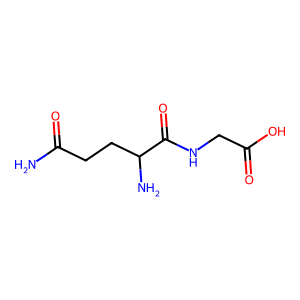 Cas:2650-65-9
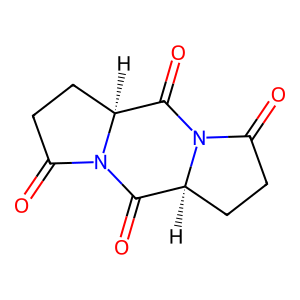 Cas:14842-41-2