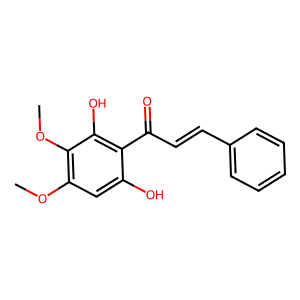
Pashanone
Names and Identifiers of Pashanone
CAS Number |
42438-78-8 |
|---|---|
IUPAC Name |
(E)-1-(2,6-dihydroxy-3,4-dimethoxyphenyl)-3-phenylprop-2-en-1-one |
InChI |
InChI=1S/C17H16O5/c1-21-14-10-13(19)15(16(20)17(14)22-2)12(18)9-8-11-6-4-3-5-7-11/h3-10,19-20H,1-2H3/b9-8+ |
InChIKey |
KVDNSLPRNTZIKF-CMDGGOBGSA-N |
Canonical SMILES |
COC1=C(C(=C(C(=C1)O)C(=O)C=CC2=CC=CC=C2)O)OC |
Isomeric SMILES |
COC1=C(C(=C(C(=C1)O)C(=O)/C=C/C2=CC=CC=C2)O)OC |
Physical and chemical properties of Pashanone
Boiling Point |
546.5±50.0 °C at 760 mmHg |
|---|---|
Density |
1.3±0.1 g/cm3 |
Exact Mass |
300.099762 |
Flash Point |
203.4±23.6 °C |
Index of Refraction |
1.637 |
LogP |
4.18 |
Molecular Formula |
C17H16O5 |
Molecular Weight |
300.306 |
PSA |
75.99000 |
Storage condition |
2-8°C |
Vapour Pressure |
0.0±1.5 mmHg at 25°C |
Applications of Pashanone
Pashanone has several applications in pharmacology and industry:
- Pharmaceuticals: Due to its antioxidant and anti-inflammatory properties, Pashanone is being explored for potential therapeutic applications in neurodegenerative diseases.
- Natural Products: As a natural compound, it is used in herbal medicine formulations.
- Research: It serves as a model compound in studies investigating flavonoid chemistry and biological activity.
Interaction Studies of Pashanone
Interaction studies involving Pashanone focus on its effects on cellular pathways. Research indicates that it modulates the NF-κB signaling pathway by inhibiting the phosphorylation of IκB-alpha, which prevents the translocation of p65 into the nucleus. This interaction underscores its potential as an anti-inflammatory agent. Furthermore, studies have demonstrated its ability to enhance Nrf2 signaling, leading to increased expression of antioxidant enzymes like HO-1.
Biological Activity of Pashanone
Pashanone exhibits significant biological activities. Studies have indicated that it possesses antioxidant properties and can protect neuronal cells from oxidative stress-induced damage. For instance, dihydropashanone, a derivative of Pashanone isolated from Lindera erythrocarpa, has been shown to inhibit the nuclear translocation of nuclear factor kappa-light-chain-enhancer of activated B cells (NF-κB), thereby reducing inflammation and protecting against neurotoxicity. The compound also influences the expression of heme oxygenase-1 (HO-1), an enzyme associated with cellular protection against oxidative damage.
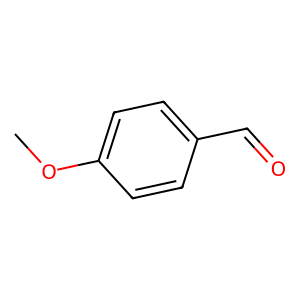 Cas:123-11-5

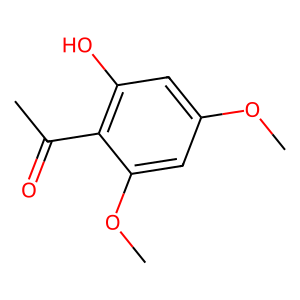 Cas:90-24-4

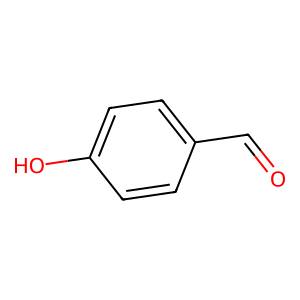 Cas:123-08-0
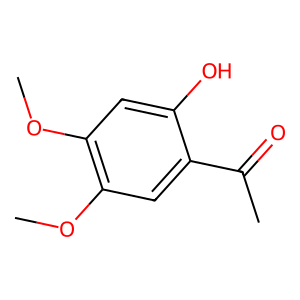 Cas:20628-06-2