
Pemirolast potassium
Names and Identifiers of Pemirolast potassium
CAS Number |
100299-08-9 |
|---|---|
EC Number |
694-774-2 |
IUPAC Name |
potassium;9-methyl-3-(1,2,3-triaza-4-azanidacyclopenta-2,5-dien-5-yl)pyrido[1,2-a]pyrimidin-4-one |
InChI |
InChI=1S/C10H7N6O.K/c1-6-3-2-4-16-9(6)11-5-7(10(16)17)8-12-14-15-13-8;/h2-5H,1H3;/q-1;+1 |
InChIKey |
NMMVKSMGBDRONO-UHFFFAOYSA-N |
Canonical SMILES |
CC1=CC=CN2C1=NC=C(C2=O)C3=NN=N[N-]3.[K+] |
UNII |
497A17OUUE |
Physical and chemical properties of Pemirolast potassium
Boiling Point |
454.8ºC at 760mmHg |
|---|---|
Exact Mass |
266.031830 |
Flash Point |
228.9ºC |
Melting Point |
310-311ºC (dec.) |
Merck |
14,7078 |
Molecular Formula |
C10H7KN6O |
Molecular Weight |
266.301 |
PSA |
77.97000 |
Solubility |
H2O: ≥18mg/mL |
Storage condition |
-20°C Freezer, Under Inert Atmosphere |
Vapour Pressure |
1.85E-08mmHg at 25°C |
Safety Information of Pemirolast potassium

Applications of Pemirolast potassium
Pemirolast potassium is primarily utilized in treating allergic conditions, particularly:
- Allergic conjunctivitis: Used in ophthalmic formulations to relieve eye itching.
- Hay fever: Alleviates symptoms associated with seasonal allergies.
- Pulmonary hypersensitivity: Investigated for its potential use in preventing reactions to certain drugs.
Moreover, its properties as a mast cell stabilizer make it a candidate for further research in managing other allergic and inflammatory conditions .
Interaction Studies of Pemirolast potassium
Interaction studies have shown that pemirolast potassium can effectively inhibit the release of various inflammatory mediators from mast cells and eosinophils. It competes with histamine for binding at H1 receptors on effector cells, thereby mitigating allergic responses . Furthermore, studies indicate that it may interact with other antihistamines or anti-inflammatory agents, although detailed interactions require further investigation.
Biological Activity of Pemirolast potassium
Pemirolast potassium exhibits notable biological activity as an antihistamine. Its primary mechanism involves binding to histamine H1 receptors, thereby blocking the action of endogenous histamine. This action alleviates symptoms such as itching and redness caused by allergic reactions. Additionally, pemirolast has been shown to inhibit eosinophil chemotaxis into ocular tissues and prevent the release of inflammatory mediators from eosinophils .
The half-life of pemirolast potassium when administered topically is approximately 4.5 hours, indicating its relatively short duration of action .
Physical sample testing spectrum (NMR) of Pemirolast potassium

 Cas:69372-19-6

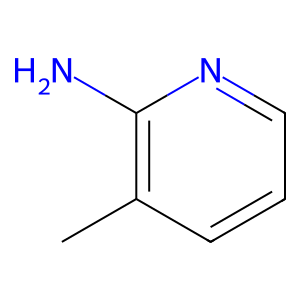 Cas:1603-40-3