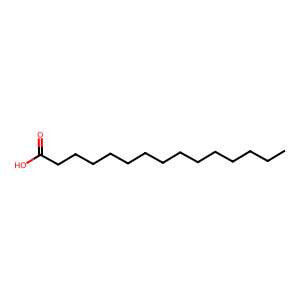
Pentadecanoic acid
Names and Identifiers of Pentadecanoic acid
CAS Number |
1002-84-2 |
|---|---|
EC Number |
213-693-1 |
MDL Number |
MFCD00002745 |
IUPAC Name |
pentadecanoic acid |
InChI |
InChI=1S/C15H30O2/c1-2-3-4-5-6-7-8-9-10-11-12-13-14-15(16)17/h2-14H2,1H3,(H,16,17) |
InChIKey |
WQEPLUUGTLDZJY-UHFFFAOYSA-N |
Canonical SMILES |
CCCCCCCCCCCCCCC(=O)O |
UNII |
CCW02D961F |
UNSPSC Code |
12352100 |
Physical and chemical properties of Pentadecanoic acid
Acidity coefficient |
4.78±0.10(Predicted) |
|---|---|
Boiling Point |
330.4±5.0 °C at 760 mmHg |
BRN |
1773831 |
Density |
0.9±0.1 g/cm3 |
Exact Mass |
242.224579 |
Flash Point |
149.6±12.5 °C |
Index of Refraction |
1.452 |
LogP |
6.62 |
Melting Point |
52.3 °C |
Molecular Formula |
C15H30O2 |
Molecular Weight |
242.398 |
PSA |
37.30000 |
Solubility |
Soluble in ethanol. |
Stability |
Stable. Combustible. Incompatible with bases, reducing agents, oxidizing agents. |
Storage condition |
−20°C |
Vapour Pressure |
0.0±0.8 mmHg at 25°C |
Water Solubility |
12mg/L(20 ºC) |
Solubility of Pentadecanoic acid
| Solvent | Dissolution Behavior | Temperature Effect | pH Effect |
|---|---|---|---|
| Water | Practically insoluble, precipitates or floats on the surface | Solubility slightly improves with increased temperature, but remains very low | Forms soluble carboxylate salts under alkaline conditions (e.g., in NaOH solution), significantly enhancing solubility; remains poorly soluble under acidic conditions |
| Ethanol | Soluble; dissolves more completely upon heating | Increased temperature promotes dissolution; moderate solubility at room temperature | Minimal pH effect, but can form salts in strongly basic ethanolic solutions, enhancing solubility |
| Diethyl ether | Readily soluble | Good solubility with increasing temperature; no significant changes | Essentially unaffected by pH (non-aqueous system) |
| Chloroform | Readily soluble | Solubility remains stable as temperature increases | Unaffected by pH |
| Acetone | Soluble | Heating accelerates dissolution rate | In alkaline conditions, may partially react to form salts, improving solubility in polar solvents |
| Benzene | Slightly soluble to soluble | Higher temperatures aid dissolution | Essentially unaffected by pH |
| Petroleum ether | Soluble (due to similar non-polarity) | Good solubility at elevated temperatures | Unaffected |
| Methanol | Soluble, especially when heated | Increased temperature significantly enhances both dissolution rate and extent | Can form methyl esters or salts in alkaline methanolic solutions, improving solubility |
Routine testing items of Pentadecanoic acid
| Test Item | Common Testing Methods | Method Overview |
|---|---|---|
| Content Assay | Gas Chromatography (GC) | Separation is performed using a capillary column with a flame ionization detector (FID). After methylation derivatization, the sample is injected, and the content of pentadecanoic acid is quantified by comparing retention times with a standard and measuring peak areas. |
| Purity Analysis | High-Performance Liquid Chromatography (HPLC) | A reverse-phase C18 column with a UV detector (~205 nm) is used. Suitable for non-volatile or thermally unstable samples, this method effectively separates impurities and evaluates purity. |
| Structural Confirmation | Fourier Transform Infrared Spectroscopy (FT-IR) | Functional groups are identified by characteristic absorption peaks, such as the strong carbonyl (—COOH) stretching vibration near 1700 cm⁻¹, along with bending and stretching vibrations of CH₂ and CH₃ groups, to confirm molecular structure. |
| Molecular Structure Identification | Mass Spectrometry (MS, GC-MS or LC-MS) | Combines chromatographic separation with mass spectrometric detection to provide precise molecular ion peaks (m/z = 242.2 for C₁₅H₂₉COOH) and fragmentation patterns for structural confirmation and impurity identification. |
| Melting Point Determination | Melting Point Apparatus | A digital melting point apparatus measures the temperature range at which the sample transitions from solid to liquid. The melting point of pentadecanoic acid is approximately 51–53°C, which can be used for preliminary assessment of purity and authenticity. |
| Acid Value Determination | Acid-Base Titration | The sample is dissolved in an ethanol-ether mixture and titrated with standardized NaOH solution to determine free carboxylic acid content. The acid value (mg KOH/g) reflects total acidity and oxidation level. |
| Water Content | Karl Fischer Titration | Quantifies trace amounts of water via an electrochemical reaction, suitable for quality control of moisture-sensitive materials to ensure storage stability. |
| Heavy Metal Residues | Atomic Absorption Spectroscopy (AAS) or ICP-MS | After sample digestion, heavy metal elements such as lead, arsenic, mercury, and cadmium are detected to ensure compliance with pharmacopoeial or food safety standards. |
| Residual Solvents | Gas Chromatography (GC) | Headspace injection-GC/FID is employed to detect residual organic solvents (e.g., methanol, ethanol, acetone) potentially left over from production, in accordance with ICH or pharmacopoeial requirements. |
| Microbial Limit Test | Microbial Cultivation Method | According to pharmacopoeial guidelines, aerobic microbial counts, mold and yeast counts, and specified control organisms (e.g., Escherichia coli, Salmonella) are tested to ensure compliance with sterility or microbial limit requirements. |
Safety Information of Pentadecanoic acid

Key Milestone of Pentadecanoic acid
| Time | Event | Description |
|---|---|---|
| 1823 | First Isolation and Preliminary Identification | French chemist Michel Eugène Chevreul first isolated several fatty acids, including pentadecanoic acid, during his study of hydrolysis products of animal fats. However, he did not name or fully characterize them at the time. |
| Mid-19th century | Systematic Naming and Structural Confirmation | With the advancement of organic chemistry, pentadecanoic acid was confirmed as a straight-chain saturated fatty acid with the molecular formula C₁₅H₃₀O₂, systematically named n-pentadecanoic acid. |
| 1930s–1950s | Initial Research as a Biomarker | Pentadecanoic acid was identified as a component of cell membrane lipids in certain bacteria (e.g., Mycobacteria), beginning its use in microbial classification studies. |
| 1970s | Discovery in Milk Fat and Ruminant Fats | Research revealed that pentadecanoic acid naturally occurs in milk, butter, and ruminant animal fats, emerging as a representative of odd-chain fatty acids (OCFAs) and attracting attention from nutritional science. |
| 1990s–2000s | Rise of Metabolic and Health-Related Research | Several epidemiological studies found associations between blood or dietary levels of pentadecanoic acid and reduced risk of type 2 diabetes and improved insulin sensitivity, driving research into its potential as a nutritional biomarker. |
| 2010s | Widespread Use as a Dietary Biomarker | Pentadecanoic acid became widely used as an objective biomarker for dairy product intake in nutritional epidemiology, due to its absence in human biosynthesis and exclusive dietary origin (primarily dairy fat). |
| 2020 | First Clinical Intervention Trial on Pentadecanoic Acid | U.S.-based institutions, including Harvard University, conducted small-scale human trials exploring the metabolic health effects of pentadecanoic acid supplementation. Initial results suggested potential anti-inflammatory effects and improved mitochondrial function. |
| 2020s–Present | Development of Potential Therapeutics and Functional Foods | Based on its metabolic regulatory properties, pentadecanoic acid is being explored in novel functional lipid research, with potential applications in metabolic syndrome, cardiovascular health, and anti-aging therapies. |
Applications of Pentadecanoic acid
Pentadecanoic acid has various applications, including:
- Nutritional Supplementation: Investigated for its potential health benefits in dietary formulations.
- Pharmaceuticals: Used in drug formulations due to its unique properties.
- Cosmetics: Incorporated into skin care products for its emollient properties.
Interaction Studies of Pentadecanoic acid
Studies have shown that pentadecanoic acid interacts with various biological systems. Notably, it has been linked to metabolic pathways involving other fatty acids. Its effects on lipid metabolism and potential anti-inflammatory properties are areas of ongoing research . Interaction studies often focus on its role compared to other fatty acids, particularly in the context of cardiovascular health.
Biological Activity of Pentadecanoic acid
Pentadecanoic acid has been studied for its potential biological activities. It is recognized for its role in human metabolism and has been suggested as a previously unrecognized essential fatty acid, comparable to eicosapentaenoic acid . Research indicates that pentadecanoic acid may have beneficial effects on cardiovascular health and metabolic processes. Its presence in human tissues has been linked to certain genetic disorders that affect fatty acid metabolism, such as Refsum disease and propionic acidemia .
Physical sample testing spectrum (NMR) of Pentadecanoic acid

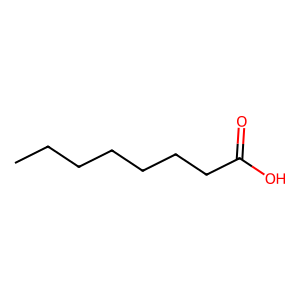 Cas:124-07-2

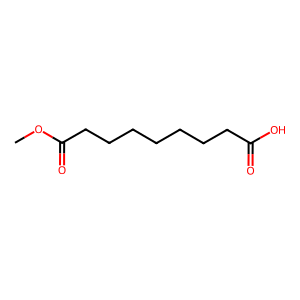 Cas:2104-19-0

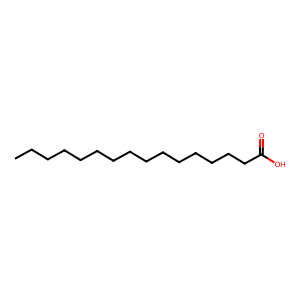 Cas:57-10-3
 Cas:92857-45-9