
Pentamidine
CAS No.:
100-33-4
M. Wt:
340.419
M. Fa:
C19H24N4O2
InChI Key:
XDRYMKDFEDOLFX-UHFFFAOYSA-N
Appearance:
White Solid
Names and Identifiers of Pentamidine
CAS Number |
100-33-4 |
|---|---|
EC Number |
202-841-0 |
MDL Number |
MFCD00599574 |
IUPAC Name |
4-[5-(4-carbamimidoylphenoxy)pentoxy]benzenecarboximidamide |
InChI |
InChI=1S/C19H24N4O2/c20-18(21)14-4-8-16(9-5-14)24-12-2-1-3-13-25-17-10-6-15(7-11-17)19(22)23/h4-11H,1-3,12-13H2,(H3,20,21)(H3,22,23) |
InChIKey |
XDRYMKDFEDOLFX-UHFFFAOYSA-N |
Canonical SMILES |
C1=CC(=CC=C1C(=N)N)OCCCCCOC2=CC=C(C=C2)C(=N)N |
UNII |
673LC5J4LQ |
UNSPSC Code |
12352100 |
Physical and chemical properties of Pentamidine
Acidity coefficient |
pKa 11.4 (Uncertain) |
|---|---|
Boiling Point |
539.4±60.0 °C at 760 mmHg |
Density |
1.2±0.1 g/cm3 |
Exact Mass |
340.189911 |
Flash Point |
280.0±32.9 °C |
Index of Refraction |
1.593 |
LogP |
4 |
Melting Point |
186.0 °C (decomposes) |
Molecular Formula |
C19H24N4O2 |
Molecular Weight |
340.419 |
PSA |
118.20000 |
Stability |
After reconstitution with sterile water, the Pentam solution is stable for 48 hours in the original vial at room temperature if protected from light. |
Storage condition |
-20°C Freezer, Under Inert Atmosphere |
Vapour Pressure |
1.66X10⁻¹⁰ mm Hg at 25 °C (est) |
Safety Information of Pentamidine

Applications of Pentamidine
Pentamidine has several clinical applications:
- Treatment of Pneumocystis pneumonia: Particularly in patients with weakened immune systems, such as those with HIV/AIDS.
- Management of Leishmaniasis: Used in both cutaneous and visceral forms of the disease.
- Treatment of Trypanosomiasis: Effective in early stages of African sleeping sickness caused by specific Trypanosoma species.
Additionally, it has been explored for off-label uses in other infections and certain inflammatory conditions due to its immunomodulatory properties.
Interaction Studies of Pentamidine
Pentamidine interacts with several other medications and biological systems:
- Drug Interactions: Caution is advised when co-administering with other agents that may affect blood pressure or blood glucose levels due to pentamidine's side effects on these parameters.
- Metabolic Interactions: The drug is metabolized primarily by Cytochrome P450 enzymes, which can influence its efficacy when combined with other drugs that utilize the same metabolic pathways.
- Toxicity Considerations: Potential toxic effects include nephrotoxicity and hematological changes; thus, monitoring during therapy is crucial.
Biological Activity of Pentamidine
Pentamidine exhibits significant biological activity against various pathogens:
- Pneumocystis jirovecii: Effective in treating Pneumocystis pneumonia, particularly in immunocompromised patients.
- Leishmania species: Acts against cutaneous and visceral leishmaniasis caused by these parasites.
- Trypanosoma species: Specifically targets Trypanosoma brucei gambiense and Trypanosoma brucei rhodesiense, responsible for sleeping sickness.
The drug's efficacy stems from its ability to disrupt multiple cellular pathways within these organisms.
Physical sample testing spectrum (NMR) of Pentamidine

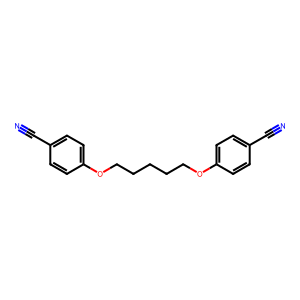 Cas:7467-71-2

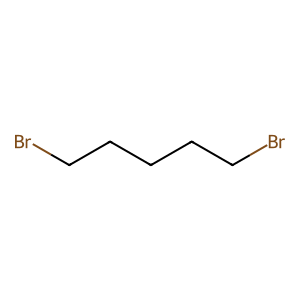 Cas:111-24-0
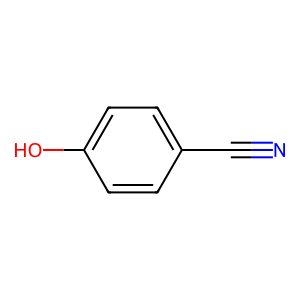 Cas:767-00-0