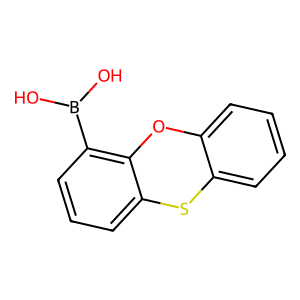
Phenoxathiin-4-boronic acid
Names and Identifiers of Phenoxathiin-4-boronic acid
CAS Number |
100124-07-0 |
|---|---|
MDL Number |
MFCD01605731 |
IUPAC Name |
phenoxathiin-4-ylboronic acid |
InChI |
InChI=1S/C12H9BO3S/c14-13(15)8-4-3-7-11-12(8)16-9-5-1-2-6-10(9)17-11/h1-7,14-15H |
InChIKey |
IIENVBUXFRSCLM-UHFFFAOYSA-N |
Canonical SMILES |
B(C1=C2C(=CC=C1)SC3=CC=CC=C3O2)(O)O |
UNSPSC Code |
12352100 |
Physical and chemical properties of Phenoxathiin-4-boronic acid
Acidity coefficient |
7.83±0.20(Predicted) |
|---|---|
Boiling Point |
457.5ºC at 760 mmHg |
Density |
1.45 g/cm3 |
Exact Mass |
244.03700 |
Index of Refraction |
1.712 |
LogP |
1.62330 |
Melting Point |
162-167 °C |
Molecular Formula |
C12H9BO3S |
Molecular Weight |
244.07400 |
PSA |
74.99000 |
Storage condition |
0-6°C |
Vapour Pressure |
3.67E-09mmHg at 25°C |
Safety Information of Phenoxathiin-4-boronic acid

Applications of Phenoxathiin-4-boronic acid
Phenoxathiin-4-boronic acid has several notable applications:
- Chemosensors: Due to its fluorescent properties when binding to sugars, it is used in developing sensors for detecting carbohydrates.
- Medicinal Chemistry: Its antibacterial activity positions it as a candidate for drug development aimed at treating bacterial infections.
- Organic Synthesis: It serves as a versatile building block in organic synthesis, particularly in the formation of complex organic molecules through cross-coupling reactions.
Interaction Studies of Phenoxathiin-4-boronic acid
Studies on phenoxathiin-4-boronic acid's interactions have highlighted its ability to form complexes with various biological molecules. Its interaction with sugars is particularly noteworthy, as it can be utilized in sensor applications due to the strong fluorescence observed upon binding. These studies are crucial for understanding its potential roles in biological systems and its applications in diagnostics and therapeutics.
Biological Activity of Phenoxathiin-4-boronic acid
Research indicates that phenoxathiin-4-boronic acid exhibits antibacterial properties. It has been identified as a potential inhibitor of bacterial growth, suggesting its utility in developing new antimicrobial agents. Additionally, its ability to bind sugars makes it a candidate for chemosensing applications due to its strong fluorescent properties when interacting with specific substrates.
Physical sample testing spectrum (NMR) of Phenoxathiin-4-boronic acid

 Cas:688-74-4
