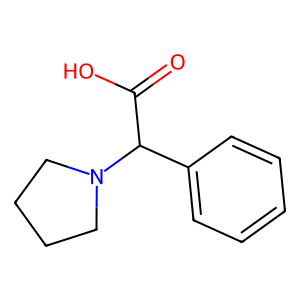
Phenyl-pyrrolidin-1-yl-acetic acid
Names and Identifiers of Phenyl-pyrrolidin-1-yl-acetic acid
CAS Number |
100390-48-5 |
|---|---|
EC Number |
675-215-1 |
MDL Number |
MFCD05237231 |
IUPAC Name |
2-phenyl-2-pyrrolidin-1-ylacetic acid |
InChI |
InChI=1S/C12H15NO2/c14-12(15)11(13-8-4-5-9-13)10-6-2-1-3-7-10/h1-3,6-7,11H,4-5,8-9H2,(H,14,15) |
InChIKey |
HYOZIYFGQLGJFY-UHFFFAOYSA-N |
Canonical SMILES |
C1CCN(C1)C(C2=CC=CC=C2)C(=O)O |
UNSPSC Code |
12352100 |
Physical and chemical properties of Phenyl-pyrrolidin-1-yl-acetic acid
Exact Mass |
205.11000 |
|---|---|
LogP |
1.84600 |
Molecular Formula |
C12H15NO2 |
Molecular Weight |
205.25300 |
PSA |
40.54000 |
Safety Information of Phenyl-pyrrolidin-1-yl-acetic acid

Applications of Phenyl-pyrrolidin-1-yl-acetic acid
Phenyl-pyrrolidin-1-yl-acetic acid has several applications:
- Pharmaceutical Development: Its potential neuroactive properties make it a candidate for developing treatments for mental health disorders.
- Biochemical Research: The compound is used in proteomics and other biochemical studies due to its ability to interact with proteins and enzymes.
- Chemical Intermediates: It serves as an intermediate in synthesizing more complex organic molecules in medicinal chemistry.
Interaction Studies of Phenyl-pyrrolidin-1-yl-acetic acid
Interaction studies involving phenyl-pyrrolidin-1-yl-acetic acid have highlighted its potential as a modulator of various receptors and enzymes. These studies often focus on:
- Receptor Binding Assays: Evaluating how the compound interacts with neurotransmitter receptors.
- Enzyme Inhibition Studies: Investigating its effects on specific enzymes involved in metabolic pathways.
These interactions provide insights into the compound's mechanism of action and potential therapeutic uses.
Biological Activity of Phenyl-pyrrolidin-1-yl-acetic acid
Phenyl-pyrrolidin-1-yl-acetic acid exhibits notable biological activity, particularly in neuropharmacology. It has been investigated for its potential effects on neurotransmitter systems, which could make it relevant in treating conditions such as anxiety and depression. Specific studies have indicated that it may modulate dopaminergic and serotonergic pathways, contributing to its psychoactive properties.
Physical sample testing spectrum (NMR) of Phenyl-pyrrolidin-1-yl-acetic acid

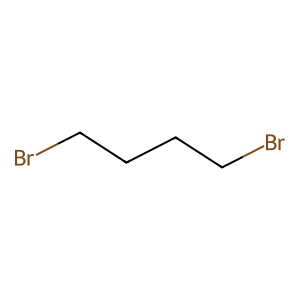 Cas:110-52-1

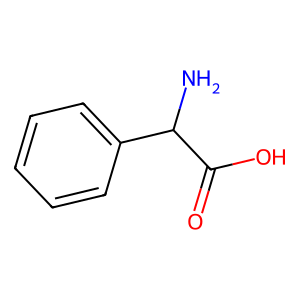 Cas:875-74-1

 Cas:123-75-1
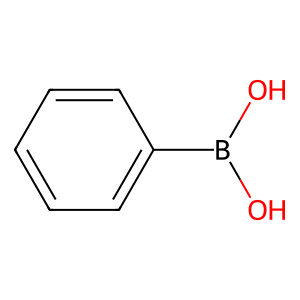 Cas:98-80-6
 Cas:298-12-4