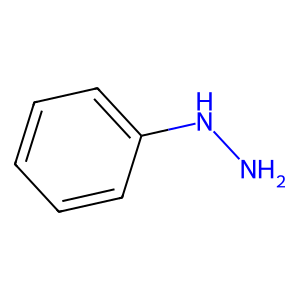
Phenylhydrazine
CAS No.:
100-63-0
M. Wt:
108.14100
M. Fa:
C6H8N2
InChI Key:
HKOOXMFOFWEVGF-UHFFFAOYSA-N
Appearance:
Pale yellow lump
Names and Identifiers of Phenylhydrazine
CAS Number |
100-63-0 |
|---|---|
EC Number |
202-873-5 |
MDL Number |
MFCD00007573 |
IUPAC Name |
phenylhydrazine |
InChI |
InChI=1S/C6H8N2/c7-8-6-4-2-1-3-5-6/h1-5,8H,7H2 |
InChIKey |
HKOOXMFOFWEVGF-UHFFFAOYSA-N |
Canonical SMILES |
C1=CC=C(C=C1)NN |
UNII |
064F424C9K |
UNSPSC Code |
12352100 |
UN Number |
2572 |
Physical and chemical properties of Phenylhydrazine
Acidity coefficient |
8.79(at 15℃) |
|---|---|
Boiling Point |
470 °F (Decomposes) |
BRN |
606080 |
Decomposition |
243.5 °C |
Density |
1.10 |
Exact Mass |
108.06900 |
explosive limit |
1.1%(V) |
Flash Point |
190 °F |
Index of Refraction |
Index of refraction: 1.60813 @ 20.3 °C/D |
LogP |
1.25 |
Melting Point |
67 °F |
Merck |
14,7293 |
Molecular Formula |
C6H8N2 |
Molecular Weight |
108.14100 |
Odor |
Faint, aromatic odor. |
PSA |
38.05000 |
Sensitivity |
Air & Light Sensitive |
Solubility |
Slight |
Stability |
Stable, but may decompose in sunlight. May be air or light sensitive. Incompatible with strong oxidizing agents, metal oxides. |
Storage condition |
Store below +30°C. |
Vapour density |
Relative vapor density (air = 1): 3.7 |
Vapour Pressure |
(77 °F): 0.04 mmHg |
Water Solubility |
145 g/L (20 ºC) |
Solubility of Phenylhydrazine
| Solvent | Dissolution Phenomenon | Temperature Effect | pH Effect |
|---|---|---|---|
| Water | Slightly soluble, forms a colorless to light yellow solution | Increasing temperature can slightly improve solubility | Stable under acidic conditions; prone to oxidation and decomposition under alkaline conditions. High pH reduces stability |
| Ethanol | Freely soluble, forms a clear solution | Solubility increases with rising temperature | Less affected by pH, but decomposition may still occur in strongly alkaline environments |
| Ether | Soluble, but with lower solubility than ethanol | Increased temperature aids dissolution | Relatively sensitive to pH; unstable under alkaline conditions |
| Benzene | Slightly soluble or insoluble | Temperature has little effect | Almost non-ionizing, pH has no significant effect |
| Acetone | Freely soluble; commonly used for preparing phenylhydrazine solutions | Solubility increases with rising temperature | Side reactions may occur under strongly alkaline conditions; pH needs to be controlled |
Safety Information of Phenylhydrazine


Key Milestone of Phenylhydrazine
| Year | Event | Person/Organization | Significance/Impact |
|---|---|---|---|
| 1875 | First synthesis of phenylhydrazine | Hermann Emil Fischer (German chemist) | Fischer successfully synthesized phenylhydrazine for the first time by reacting aniline with sodium nitrite under acidic conditions, followed by reduction with hydrazine sulfate, laying the foundation for his future research. |
| 1884 | Discovery that phenylhydrazine reacts with sugars to form osazones | Hermann Emil Fischer | Phenylhydrazine reacts with reducing sugars to form characteristic crystalline osazones, becoming an important method for identifying sugar structures and promoting the development of carbohydrate chemistry. |
| 1880s–1890s | Used in the structural analysis of sugars | Hermann Emil Fischer et al. | Using phenylhydrazine derivatization techniques, Fischer successfully elucidated the stereochemical configurations of monosaccharides such as glucose, a key contribution that led to his receiving the Nobel Prize in Chemistry in 1902. |
| 1900s | Broadly applied as an organic synthesis intermediate | Multitudes of chemists | Phenylhydrazine was used in the synthesis of heterocyclic compounds such as indoles and pyrazolines, playing an important role in pharmaceutical and dye synthesis. |
| 1930s–1940s | Used in drug development (e.g., anti-inflammatory and anti-tuberculosis drugs) | Pharmaceutical industry | Phenylhydrazine derivatives were explored for therapeutic uses; for example, isoniazid (though not directly synthesized from phenylhydrazine, was inspired by hydrazine chemistry). |
| 1940s–1950s | Discovery of phenylhydrazine's toxicity and carcinogenicity | Toxicology researchers | Studies showed that phenylhydrazine has hemolytic, hepatotoxic, and potential carcinogenic effects, prompting enhanced safety measures in laboratory and industrial applications. |
| 1950s–Present | Used as an analytical reagent in biochemical analysis | Field of analytical chemistry | Phenylhydrazine is still used in qualitative and quantitative analysis of specific aldehydes, ketones, or sugars (although 2,4-dinitrophenylhydrazine is more commonly used, phenylhydrazine still holds a place in classical methods). |
| 1970s–Present | Exploratory applications in materials science | Research institutions | Phenylhydrazine and its derivatives have been used to synthesize polymers, liquid crystals, or metal complexes, expanding their applications in the field of functional materials. |
Applications of Phenylhydrazine
Phenylhydrazine has diverse applications:
- Synthesis of Indoles: It plays a crucial role in the Fischer indole synthesis, producing indoles that are important intermediates in pharmaceuticals and dyes.
- Sugar Analysis: The compound is used to form phenylhydrazones from simple sugars, facilitating their separation and analysis.
- Pharmacological Research: Due to its ability to induce hemolytic anemia, it serves as a model compound for studying blood disorders.
Biological Activity of Phenylhydrazine
Phenylhydrazine exhibits significant biological activity, particularly in the context of inducing hemolytic anemia in animal models. It has been shown to interact with red blood cells, causing oxidative stress and changes in blood pigment levels, which can lead to hemolysis and liver damage. The compound is classified as a potential occupational carcinogen and has been associated with mutagenic effects in several studies.
Physical sample testing spectrum (NMR) of Phenylhydrazine

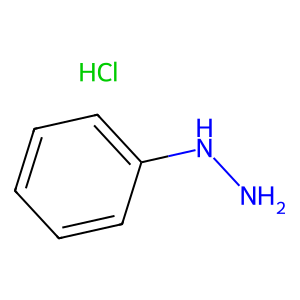 Cas:59-88-1

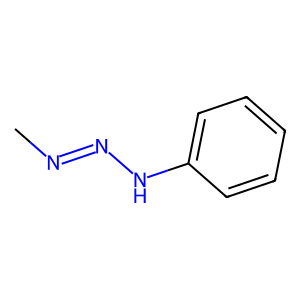 Cas:16033-21-9

 Cas:7664-41-7
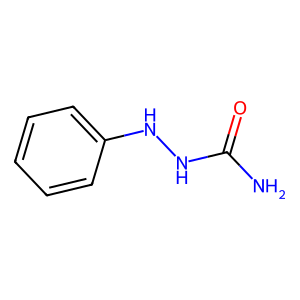 Cas:103-03-7
 Cas:7647-01-0