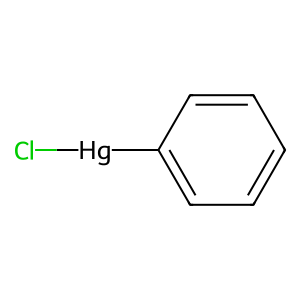
Phenylmercuric chloride
CAS No.:
100-56-1
M. Wt:
313.14700
M. Fa:
C6H5ClHg
InChI Key:
AWGTVRDHKJQFAX-UHFFFAOYSA-M
Appearance:
White To Light Yellow Powder To Lump
Names and Identifiers of Phenylmercuric chloride
CAS Number |
100-56-1 |
|---|---|
EC Number |
202-865-1 |
IUPAC Name |
chloro(phenyl)mercury |
InChI |
InChI=1S/C6H5.ClH.Hg/c1-2-4-6-5-3-1;;/h1-5H;1H;/q;;+1/p-1 |
InChIKey |
AWGTVRDHKJQFAX-UHFFFAOYSA-M |
Canonical SMILES |
C1=CC=C(C=C1)[Hg]Cl |
Physical and chemical properties of Phenylmercuric chloride
BRN |
3536717 |
|---|---|
Decomposition |
Phenylmercury salts & methoxyalkylmercury cmpd decompose readily & release mercury vapor /Phenyl mercury salts/ |
Exact Mass |
313.97900 |
Exposure Limits |
ACGIH: TWA 0.1 mg/m3 (Skin) NIOSH: IDLH 10 mg/m3; TWA 0.05 mg/m3; Ceiling 0.1 mg/m3 |
LogP |
log Kow= 1.78 |
Melting Point |
250-252 °C |
Merck |
14,7301 |
Molecular Formula |
C6H5ClHg |
Molecular Weight |
313.14700 |
Stability |
Alkyl mercurials are very stable relative to aryl mercurials such as phenylmercury, which is rapidly broken down into Hg2+ in animals ... and the soil. /Mercurials/ |
Storage condition |
Poison room |
Vapour Pressure |
0.02 [mmHg] |
Water Solubility |
Soluble in benzene, ether, pyridine. Very slightly soluble in water |


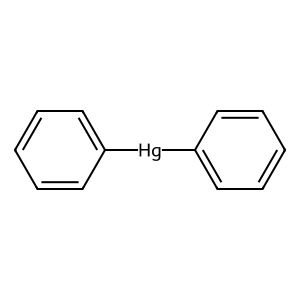 Cas:587-85-9

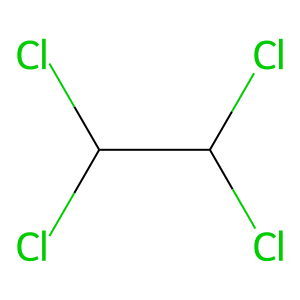 Cas:79-34-5

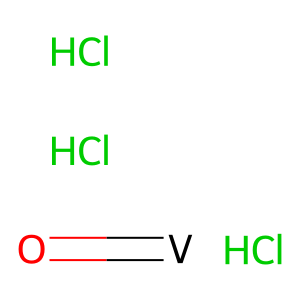 Cas:7727-18-6
 Cas:71-43-2
 Cas:98-09-9