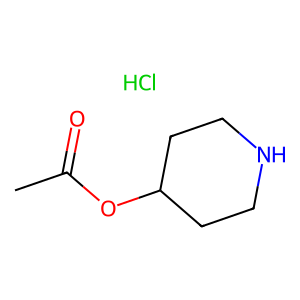
Piperidin-4-yl acetate hydrochloride
Names and Identifiers of Piperidin-4-yl acetate hydrochloride
CAS Number |
94886-04-1 |
|---|---|
IUPAC Name |
piperidin-4-yl acetate;hydrochloride |
InChI |
InChI=1S/C7H13NO2.ClH/c1-6(9)10-7-2-4-8-5-3-7;/h7-8H,2-5H2,1H3;1H |
InChIKey |
UDSMCVVEFKCVIM-UHFFFAOYSA-N |
Canonical SMILES |
CC(=O)OC1CCNCC1.Cl |
Physical and chemical properties of Piperidin-4-yl acetate hydrochloride
Boiling Point |
235.3ºC at 760 mmHg |
|---|---|
Exact Mass |
179.07100 |
Flash Point |
96.1ºC |
LogP |
1.43230 |
Molecular Formula |
C7H14ClNO2 |
Molecular Weight |
179.64500 |
PSA |
38.33000 |
Safety Information of Piperidin-4-yl acetate hydrochloride

Applications of Piperidin-4-yl acetate hydrochloride
Piperidin-4-yl acetate hydrochloride has several applications, particularly in medicinal chemistry and pharmaceutical research. Its potential biological activity makes it a candidate for:
- Neuropharmacology: Investigating its effects on neurotransmitter systems.
- Chemical Synthesis: Serving as an intermediate in the synthesis of other compounds with therapeutic potential.
- Research: Used in studies related to acetylcholinesterase activity and other enzymatic processes in the brain.
Interaction Studies of Piperidin-4-yl acetate hydrochloride
Interaction studies involving piperidin-4-yl acetate hydrochloride focus on its effects on various biological systems. These studies are crucial for assessing the safety and efficacy of compounds derived from or related to this compound. For instance, research has shown that derivatives can specifically inhibit acetylcholinesterase, which is important for understanding their pharmacological profiles.
Biological Activity of Piperidin-4-yl acetate hydrochloride
Research indicates that piperidin-4-yl acetate hydrochloride may possess various biological activities. It has been studied for its potential pharmacological effects, including interactions with neurotransmitter systems. Notably, derivatives of this compound have been explored for their effects on acetylcholinesterase activity, which is crucial for neurotransmission in the brain. The biological activity of piperidin-4-yl acetate hydrochloride is still under investigation, with ongoing studies focusing on its potential neuropharmacological applications.