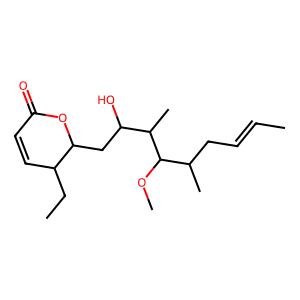
Pironetin
Names and Identifiers of Pironetin
CAS Number |
151519-02-7 |
|---|---|
IUPAC Name |
(2R,3R)-3-ethyl-2-[(E,2R,3S,4R,5S)-2-hydroxy-4-methoxy-3,5-dimethylnon-7-enyl]-2,3-dihydropyran-6-one |
InChI |
InChI=1S/C19H32O4/c1-6-8-9-13(3)19(22-5)14(4)16(20)12-17-15(7-2)10-11-18(21)23-17/h6,8,10-11,13-17,19-20H,7,9,12H2,1-5H3/b8-6+/t13-,14-,15+,16+,17+,19+/m0/s1 |
InChIKey |
XIHGDBYGUWEHCV-FSEPSNHWSA-N |
Canonical SMILES |
CCC1C=CC(=O)OC1CC(C(C)C(C(C)CC=CC)OC)O |
Isomeric SMILES |
CC[C@@H]1C=CC(=O)O[C@@H]1C[C@H]([C@H](C)[C@@H]([C@@H](C)C/C=C/C)OC)O |
Physical and chemical properties of Pironetin
Acidity coefficient |
14.28±0.20(Predicted) |
|---|---|
Boiling Point |
473.1ºC at 760 mmHg |
Density |
0.993 g/cm3 |
Exact Mass |
324.23000 |
Flash Point |
160.3ºC |
Index of Refraction |
1.478 |
LogP |
3.49860 |
Melting Point |
75-77 °C |
Molecular Formula |
C19H32O4 |
Molecular Weight |
324.45500 |
PSA |
55.76000 |
Vapour Pressure |
6.14E-11mmHg at 25°C |
Applications of Pironetin
Pironetin's primary application lies in cancer therapy due to its ability to inhibit microtubule formation. Its unique interaction with tubulin makes it a candidate for developing new anticancer drugs. Additionally, studies suggest potential applications in plant growth regulation and immunosuppression, although these areas require further exploration.
Interaction Studies of Pironetin
Research into pironetin's interactions with tubulin has revealed critical insights into its mechanism of action. The binding of pironetin to α-tubulin not only inhibits polymerization but also alters the structural dynamics between tubulin heterodimers. This perturbation is essential for understanding how pironetin competes with other microtubule-targeting agents like vinblastine and colchicine.
Notable Interactions:- Covalent Binding: Cysteine-316 on α-tubulin.
- Structural Changes: Perturbations in the T7 loop and helix H8 of α-tubulin.
Biological Activity of Pironetin
Pironetin is classified as a microtubule-targeting agent, making it a potent inhibitor of tubulin polymerization. Its ability to disrupt microtubule dynamics is essential for its anticancer properties, as it interferes with cell division and proliferation. In vitro studies have demonstrated that pironetin can induce apoptosis in various cancer cell lines, highlighting its potential as an effective chemotherapeutic agent.
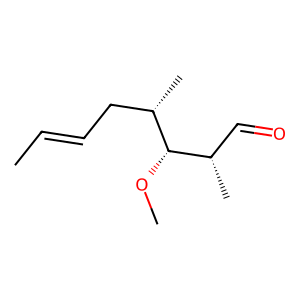 Cas:332842-68-9

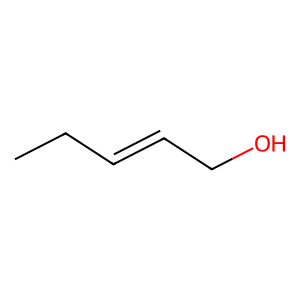 Cas:1576-96-1
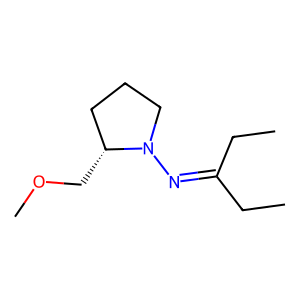 Cas:59983-36-7