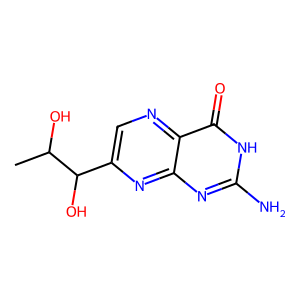
Primapterin
CAS No.:
2582-88-9
M. Wt:
237.21500
M. Fa:
C9H11N5O3
InChI Key:
LNXRKRFGNHXANN-UHFFFAOYSA-N
Names and Identifiers of Primapterin
CAS Number |
2582-88-9 |
|---|---|
IUPAC Name |
2-amino-7-(1,2-dihydroxypropyl)-3H-pteridin-4-one |
InChI |
InChI=1S/C9H11N5O3/c1-3(15)6(16)4-2-11-5-7(12-4)13-9(10)14-8(5)17/h2-3,6,15-16H,1H3,(H3,10,12,13,14,17) |
InChIKey |
LNXRKRFGNHXANN-UHFFFAOYSA-N |
Canonical SMILES |
CC(C(C1=CN=C2C(=O)NC(=NC2=N1)N)O)O |
Physical and chemical properties of Primapterin
Boiling Point |
564.5ºC at 760mmHg |
|---|---|
Density |
1.86g/cm3 |
Exact Mass |
237.08600 |
Flash Point |
295.2ºC |
Molecular Formula |
C9H11N5O3 |
Molecular Weight |
237.21500 |
PSA |
139.00000 |
Applications of Primapterin
Primapterin has potential applications in several fields:
- Clinical Diagnostics: As a marker for metabolic disorders such as phenylketonuria, it could aid in early diagnosis and management.
- Biochemical Research: Its role in enzymatic reactions makes it valuable for studying metabolic pathways and developing therapeutic strategies for related disorders.
Interaction Studies of Primapterin
Research on primapterin's interactions primarily focuses on its role as a cofactor. Studies have shown that:
- Enzymatic Interactions: Primapterin interacts with enzymes like phenylalanine hydroxylase, affecting their activity and stability. Mutations affecting these interactions can lead to metabolic disorders.
- Metabolic Pathway Studies: Understanding how primapterin interacts within metabolic pathways can provide insights into its function and potential therapeutic uses.
Biological Activity of Primapterin
Primapterin exhibits biological activity primarily through its role as a cofactor in enzymatic reactions. Its presence has been linked to:
- Amino Acid Metabolism: It aids in the metabolism of phenylalanine and other aromatic amino acids, which is critical for neurotransmitter synthesis.
- Potential Biomarker: Elevated levels of primapterin may indicate metabolic disorders such as atypical phenylketonuria.