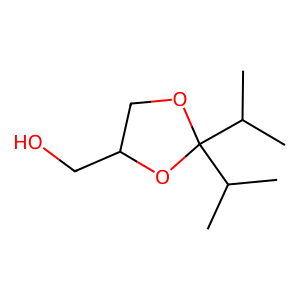
Promoxolane
Names and Identifiers of Promoxolane
CAS Number |
470-43-9 |
|---|---|
IUPAC Name |
[2,2-di(propan-2-yl)-1,3-dioxolan-4-yl]methanol |
InChI |
InChI=1S/C10H20O3/c1-7(2)10(8(3)4)12-6-9(5-11)13-10/h7-9,11H,5-6H2,1-4H3 |
InChIKey |
HHFOOWPWAXNJNY-UHFFFAOYSA-N |
Canonical SMILES |
CC(C)C1(OCC(O1)CO)C(C)C |
UNII |
JHI9RRY52E |
Physical and chemical properties of Promoxolane
Boiling Point |
246.8ºC at 760mmHg |
|---|---|
Density |
0.98g/cm3 |
Exact Mass |
188.14100 |
Flash Point |
118.4ºC |
Index of Refraction |
1.443 |
LogP |
1.40240 |
Molecular Formula |
C10H20O3 |
Molecular Weight |
188.26400 |
PSA |
38.69000 |
Vapour Pressure |
0.00437mmHg at 25°C |
Safety Information of Promoxolane

Applications of Promoxolane
Promoxolane has several applications in medicine:
- Anxiolytic Treatment: It is primarily used to manage anxiety disorders by providing rapid relief from anxiety symptoms.
- Muscle Relaxation: The compound is effective in treating conditions characterized by muscle tension or spasms.
- Research Tool: In pharmacological research, Promoxolane serves as a model compound for studying central nervous system depressants and their effects on neurotransmission.
These applications underscore Promoxolane's significance in both clinical and research settings.
Interaction Studies of Promoxolane
Interaction studies involving Promoxolane have revealed important information regarding its pharmacokinetics and potential drug-drug interactions. Key findings include:
- Synergistic Effects: When combined with other central nervous system depressants, Promoxolane may enhance sedative effects, necessitating caution in co-administration.
- Metabolic Pathways: Understanding how Promoxolane is metabolized can inform potential interactions with drugs that affect liver enzymes involved in its clearance.
These studies are crucial for optimizing therapeutic regimens involving Promoxolane and ensuring patient safety.
Biological Activity of Promoxolane
Promoxolane exhibits significant biological activity as a muscle relaxant and anxiolytic agent. Its mechanism involves modulation of neurotransmitter systems within the central nervous system, particularly enhancing inhibitory signals that lead to decreased muscle tension and anxiety levels. The drug's effects are primarily mediated through interactions with gamma-aminobutyric acid receptors, which play a pivotal role in regulating neuronal excitability.
In pharmacological studies, Promoxolane has demonstrated effectiveness in reducing muscle spasms and providing relief from anxiety symptoms, making it a valuable therapeutic option in clinical practice.
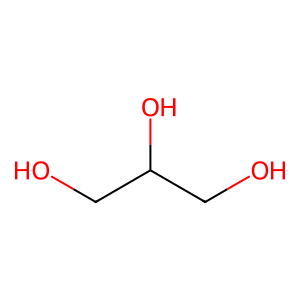 Cas:56-81-5

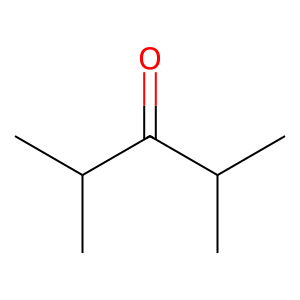 Cas:565-80-0
