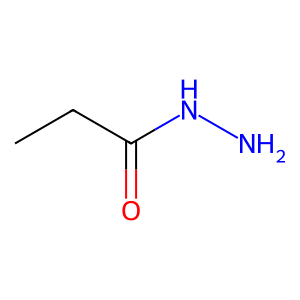
Propionohydrazide
CAS No.:
5818-15-5
M. Wt:
88.108
M. Fa:
C3H8N2O
InChI Key:
DXGIRFAFSFKYCF-UHFFFAOYSA-N
Appearance:
Off White Crystalline Powder
Names and Identifiers of Propionohydrazide
CAS Number |
5818-15-5 |
|---|---|
EC Number |
227-390-7 |
MDL Number |
MFCD01333200 |
IUPAC Name |
propanehydrazide |
InChI |
InChI=1S/C3H8N2O/c1-2-3(6)5-4/h2,4H2,1H3,(H,5,6) |
InChIKey |
DXGIRFAFSFKYCF-UHFFFAOYSA-N |
Canonical SMILES |
CCC(=O)NN |
UNII |
K4H0YVF8J4 |
UNSPSC Code |
12352100 |
Physical and chemical properties of Propionohydrazide
Acidity coefficient |
13.46±0.18(Predicted) |
|---|---|
Boiling Point |
243.3±9.0 °C at 760 mmHg |
Density |
1.0±0.1 g/cm3 |
Exact Mass |
88.063660 |
Flash Point |
100.9±18.7 °C |
Index of Refraction |
1.440 |
LogP |
-1.11 |
Melting Point |
179-180 °C |
Molecular Formula |
C3H8N2O |
Molecular Weight |
88.108 |
PSA |
55.12000 |
Vapour Pressure |
0.0±0.5 mmHg at 25°C |
Safety Information of Propionohydrazide

Applications of Propionohydrazide
Propionohydrazide finds applications across various fields:
- Pharmaceutical Industry: It serves as an intermediate in the synthesis of pharmaceuticals, particularly those targeting infectious diseases and cancer.
- Agricultural Chemicals: The compound is also explored for use in agrochemicals due to its biological activity against pathogens.
- Material Science: Propionohydrazide can be used in the development of polymers and other materials that require specific chemical properties derived from hydrazine functionalities.
Biological Activity of Propionohydrazide
Propionohydrazide exhibits various biological activities, making it a subject of interest in pharmacological research:
- Antimicrobial Properties: Studies have indicated that propionohydrazide and its derivatives possess antimicrobial activity against certain bacterial strains, suggesting potential applications in developing new antibiotics.
- Antitumor Activity: Some derivatives of propionohydrazide have shown promise in inhibiting tumor growth, indicating potential use in cancer therapy. The mechanism often involves interference with cellular metabolism and proliferation pathways.
Physical sample testing spectrum (NMR) of Propionohydrazide

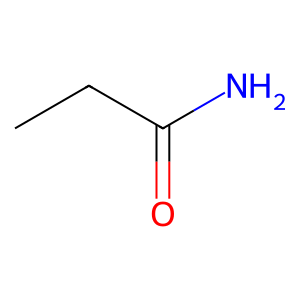 Cas:79-05-0

 Cas:79-09-4
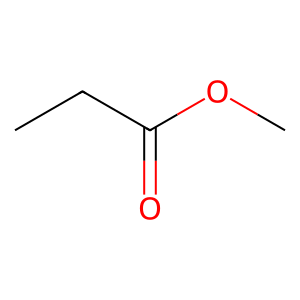 Cas:554-12-1